
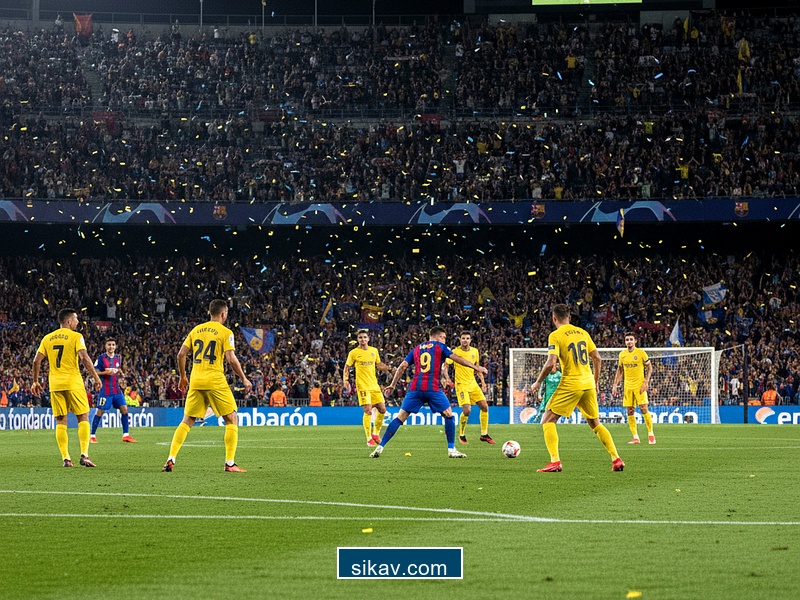
There is a distinct, metallic taste to a victory at the Estadio de la Cerámica—formerly El Madrigal—that usually signals a title charge. Barcelona’s 0-2 triumph over Villarreal was not a symphony conducted by the ghost of Johan Cruyff, nor was it the sterile, hypnotic possession dominance of the Pep Guardiola era. It was something arguably more valuable in the modern game: efficient, cynical, and brutally vertical.
While the scoreline reads as a comfortable win, the narrative surrounding the club is fracturing into two distinct realities. On the pitch, we are witnessing a team exorcising the fragility of the post-Messi hangover. Off the pitch, as evidenced by the noise surrounding potential La Liga matches in the United States, the club remains a commercial entity desperate for liquidity.
The Ghost of Eto’o and the New Lethality
To understand the significance of this 0-2 result, one must look back nearly two decades. In the 2005-06 season, Frank Rijkaard’s Barcelona arrived at this same venue. That team, spearheaded by Ronaldinho and a merciless Samuel Eto’o, played with a joyful arrogance. Eto’o, who would go on to win the Pichichi with 26 goals that season, defined the "killer" instinct.
Watching Robert Lewandowski operate in this match offered a striking historical parallel, yet a tactical divergence. Eto’o was chaos manifest—a player who pressed defenders into panic and utilized blistering pace. Lewandowski, conversely, is a surgeon operating in a phone booth. His movement to create the opening goal wasn't about speed; it was about spatial manipulation that would have made Thierry Henry nod in approval during his 2009 stint in Catalonia.
The modern Barcelona cannot afford the luxury of missing chances. In 2009, with Xavi Hernandez and Andres Iniesta controlling 70% of the ball, a missed chance was a statistical anomaly to be corrected five minutes later. Today, against a Villarreal side known for their transition threat, possession is often closer to 55-60%. The margin for error has vanished. This 0-2 victory highlights a team that has finally learned to suffer without collapsing—a trait the 2018-2021 squads severely lacked.
Tactical Evolution: From Rondo to Direct Verticality
The most jarring disconnect for purists watching this fixture is the death of the relentless horizontal pass. Under the current tactical setup, Barcelona has embraced a verticality that resembles the Luis Enrique treble-winning side of 2015 more than the Guardiola ideal of 2011.
"We should be in Miami." — A sentiment echoing through the executive offices, juxtaposed against the grit required in Vila-real.
Villarreal, historically one of the most technically gifted sides in Spain (reminiscent of their Riquelme-Forlan heyday in 2005), creates traps in the midfield. The Barcelona of a decade ago would have tried to pass through those traps with short triangulations. In this match, the solution was often a bypass: a direct ball over the top or a rapid switch of play to Lamine Yamal.
This brings us to the elephant in the room: Lamine Yamal compared to the debut era of Lionel Messi (2004-2007). When Messi was breaking through, he was protected by Deco and Ronaldinho. He was the cherry on top. Yamal is being asked to be the cake, the icing, and the table it sits on. The reliance on his isolation play on the wing is terrifyingly similar to the "Messidependencia" that plagued the club in the late 2010s, but Yamal is doing it as a teenager. His performance against Villarreal showed maturity, but the historical physical data on players with this workload at this age (think Pedri’s burnout or Ansu Fati’s knees) is a flashing red light the coaching staff seems determined to ignore.
The Miami Distraction and the Soul of La Liga
While the players were battling for three points in the Castellón province, the shadow of Javier Tebas’s American dream loomed large. The report from The Athletic regarding the push for a La Liga match in Miami is not merely an administrative footnote; it is an existential threat to the competitive integrity displayed in this very match.
A fixture like Villarreal vs. Barcelona derives its heat from the local hostility. The Estadio de la Cerámica is a cauldron. Transporting a fixture—whether it be this one or a clash with Atlético—to the Hard Rock Stadium in Miami strips the contest of its tribal context. It turns a war for points into an exhibition for tourists.
Historically, Barcelona has been the club of "Més que un club" (More than a club). In 2006, they paid UNICEF to wear their logo. Today, the conversation is about sacrificing home advantage or domestic travel rhythms for U.S. dollars. This victory against Villarreal was crucial because it keeps the team grounded in the reality of the league table, away from the marketing spreadsheets that threaten to turn La Liga into a traveling circus akin to the Harlem Globetrotters.
Comparative Analysis: The Engine Room
The 0-2 clean sheet also demands a conversation about the defensive pivot. For over a decade, Sergio Busquets defined the role of the '4' globally. He was the lighthouse. We are now seeing the difficult evolution of that position. The current midfield configuration relies less on cerebral positioning and more on physical coverage.
| Attribute | 2009 Era (Busquets/Touré) | Current Era (Casadó/Bernal/De Jong) |
|---|---|---|
| Possession Retention | 92%+ Pass Accuracy (Safety first) | 85-88% (High risk verticality) |
| Press Resistance | Technical turns, utilizing the 'Rondo' | Physical shielding, carrying the ball |
| Defensive Transition | Positional interception | Recovery sprints and tactical fouls |
Against Villarreal, the midfield battle was won not because Barcelona out-passed the opposition, but because they won the second balls. This is the "Germanification" of Barcelona—a shift likely influenced by modern European trends where athleticism reigns supreme. It is less beautiful than the 2011 symphony, but against a team like Villarreal that transitions with lethal speed, it is the only way to survive.
The Verdict
A 0-2 win at Villarreal is a statement. In 2008-09, Guardiola’s team drew 3-3 here, delaying a title celebration. That team was arguably the greatest in history, yet they struggled to contain the Yellow Submarine at El Madrigal. The fact that this flawed, financially stricken, injury-riddled iteration of Barcelona went there and kept a clean sheet speaks volumes about their mental fortitude.
They are not the artists of 2009. They are scavengers, fighters, and opportunists. And if they want to keep the league title in Catalonia—and keep the matches in Spain rather than Florida—they will need to maintain this ruthless efficiency every single week.