
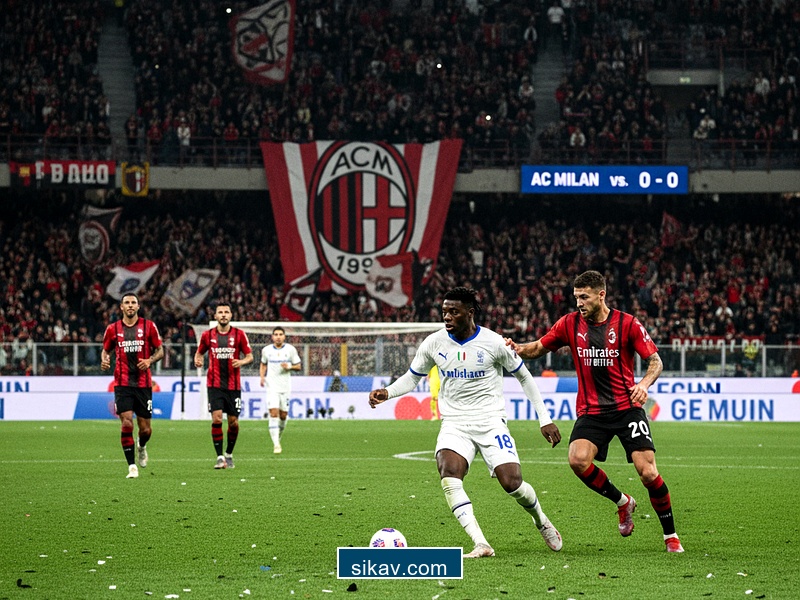
The rumor mill regarding AC Milan and Christopher Nkunku is churning, suggesting the Rossoneri are monitoring the Frenchman’s situation at Chelsea. To the casual observer, this is a story about a big club circling a distressed asset. To a professional scout, however, this is a fascinating study in biomechanical risk assessment and tactical geometry. We aren't just looking at a transfer; we are looking at Milan attempting to solve a specific structural defect in their final third.
Having watched Nkunku since his PSG academy days, through the RB Leipzig explosion, and into the staccato rhythm of his Chelsea tenure, the profile is clear. He is not a traditional playmaker, nor is he a pure poacher. He is a "space interpreter" in the truest sense. But to understand why Milan is interested, we must strip away the stat sheet and look at the tape—specifically, the movements he makes when the camera isn't zooming in on the ball carrier.
The Biomechanics of the 'Half-Turn'
In modern scouting, we obsess over "receiving mechanics." Most players receive the ball, stop it, and then look for a solution. Elite technicians scan before arrival. Nkunku operates on a higher tier: he receives on the half-turn while simultaneously initiating his drive. This is a specific hip-rotation capability that allows him to eliminate the first line of pressure without touching the ball.
Watch his tape from Leipzig’s 2021-22 season. His ability to receive the ball in the "pockets"—the zones between the opposition midfield and defensive lines—is world-class. When he drops deep, his body shape is rarely square to the ball. He angles his shoulders at 45 degrees. This body orientation sends a false signal to the pressing center-back: "I am holding the ball up." In reality, his center of gravity is already shifting for a spin.
For Milan, a team that often struggles to break down the low-block catenaccio of mid-table Serie A sides, this micro-movement is the missing link. Current options like Ruben Loftus-Cheek offer vertical power and ball-carrying mass, but they lack that fluid, frictionless turn in tight traffic. Nkunku offers "La Pausa"—the ability to freeze a defender with a subtle hesitation—combined with explosive acceleration.
Deceleration and the Injury Red Flag
We cannot discuss Nkunku without addressing the medical elephant in the room. Why is Milan considering a player with such a jagged injury history? It comes down to the difference between "impact injuries" and "load compromise."
Nkunku’s muscular issues at Chelsea stem from his style of play. He is an incredibly high-twitch athlete. His game relies on violent deceleration—going from 30km/h to zero in two steps to cut inside. This puts immense eccentric load on the hamstrings and knee ligaments. In the Premier League, the transition speed is relentless, offering zero recovery time during active play.
Serie A is different. It is tactical, chess-like, and significantly slower in transition frequency. The "Milan Lab" assessment likely projects that the lower volume of high-intensity sprints in Italy reduces the risk of recurrence. Milan is betting that Nkunku isn't "injury prone" in a vacuum, but rather incompatible with the chaotic, relentless verticality of English football physically. It’s a calculated gamble on environment changing physiology.
Tactical Theory: The 'Shadow Striker' in a 4-2-3-1
Where does he fit? This is where the scout’s eye moves to off-ball pathing. Nkunku is the archetype of a "Shadow Striker" (or Seconda Punta). He is not a target man. If Milan tries to use him as a lone 9 to replace Olivier Giroud’s aerial dominance or Morata's channel running, they will fail.
"The most dangerous run is the one the defender sees too late. Nkunku masters the 'Blind Side' run—arcing his movement behind the center-back’s peripheral vision just as the ball is released."
Imagine the partnership with Rafael Leão. Leão demands the ball to feet on the wide left, often attracting two or three defenders. This creates a vacuum in the left half-space. Currently, Milan midfielders often crash the box too early or too late. Nkunku’s timing is impeccable. He arrives in that vacuum exactly as the cutback is engaged.
Furthermore, Nkunku’s defensive work rate is often undervalued. Having been schooled in the Red Bull philosophy, his pressing triggers are automatic. He understands "cover shadows"—positioning himself to block passing lanes while closing down the keeper. This allows Milan to employ a high press without sacrificing structure, a balance they have struggled to find in big European nights.
The 'Gravity' Metric
Advanced analytics now track "gravity"—how much a player distorts the defensive shape simply by standing in a specific zone. Nkunku has elite gravity. Because he is lethal from 20 yards and quick enough to run in behind, defenders cannot sag off him, nor can they get too tight. This indecision creates space for teammates.
Christian Pulisic, another Chelsea expat finding redemption at San Siro, thrives on this chaos. If Nkunku occupies the central defenders, Pulisic’s diagonal runs from the right become significantly more potent. We aren't just looking at adding a player; we are looking at a force multiplier for the existing attack.
The Verdict: High Risk, Maximum Reward
This potential move mirrors the signing of Christian Pulisic: a high-ceiling talent marginalized by the bloated squad dynamics of Stamford Bridge. However, the risk profile is higher due to the medical charts. But in a market where elite, technical 10s cost upwards of €80 million, picking up Nkunku on a structured deal represents a massive market inefficiency exploit.
If Milan’s medical team believes his kinetic chain can handle the rigors of Calcio, Nkunku doesn't just improve the starting XI; he evolves the tactical identity of the club. He transforms them from a team relying on individual brilliance on the wings to a team capable of dissecting defenses through the center.
The scout’s report is clear: The talent is generational, the movement is elite, and the fit is perfect. The only question remains—can his body survive the answer?