
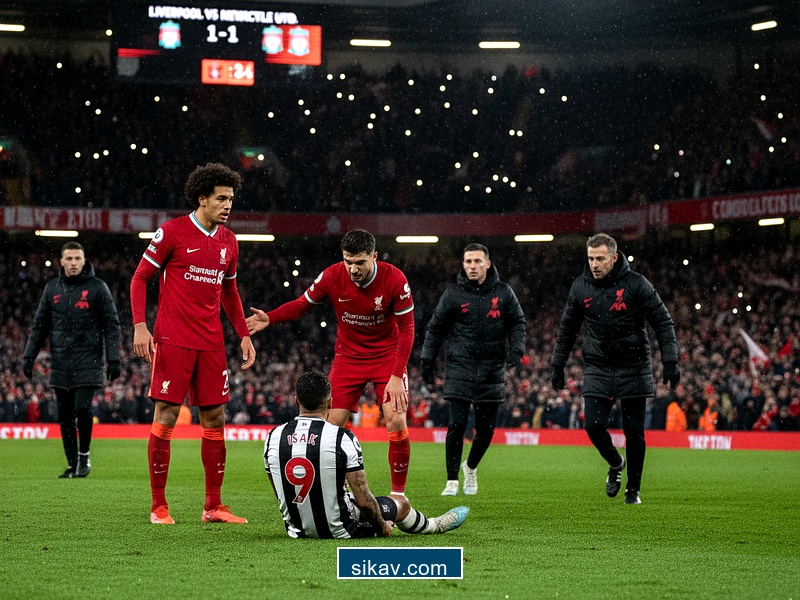
The silence at Anfield was not born of shock, but of recognition. When Alexander Isak pulled up—decelerating sharply without a defender within two yards of his orbit—the collective intake of breath was the sound of a tactical blueprint dissolving in real-time. We have seen this specific mechanical failure before.
Reports emerging from the corridors of the AXA Training Centre suggest Liverpool’s medical department fears a "significant" layout for the Swedish international. For the casual observer, an injury is bad luck. For the professional scout, watching Isak clutch his hamstring or adductor after a high-velocity braking maneuver is a confirmation of a long-held fear regarding his distinct somatotype. This isn't just a missing player; it is a structural collapse of the central channel.
The Fragility of the "Glider" Profile
To understand why Liverpool’s recruitment team and coaching staff are currently in a state of high anxiety, you must look at Isak not as a goal scorer, but as a kinetic machine. Isak is 6'4" but moves with the agility of a winger standing 5'9". In scouting terms, we categorize this as a "Glider" profile. Unlike Erling Haaland, who relies on brute posterior chain power and contact, Isak relies on elasticity and exaggerated stride length.
The mechanism of the injury, based on the video analysis of the incident, appears to be a failure during the eccentric loading phase. Isak was transitioning from a sprint to a lateral cut. When a player of his height and high center of gravity attempts to decelerate instantly to exploit a half-space, the torque placed on the tendon junctions is immense.
"The danger for Isak has never been the tackle; it is the turf. His biomechanics involve extreme hip internal rotation when he dribbles. He creates angles that defy his skeletal frame. When the muscle fatigues, that elasticity snaps."
This is the tax on elegance. We saw similar attrition rates with Thierry Henry in his late 20s and, more pertinently, Fernando Torres. The long levers that allow Isak to wrap his leg around a defender also act as long moment arms for injury risk. If the report indicates a Grade 3 tear in the hamstring or a proximal tendon avulsion, we are looking at a fundamental inability to replicate his explosive movements for the remainder of the campaign.
Tactical Fallout: The Shadow Striker Role
Arne Slot’s Liverpool has evolved away from the chaotic heavy metal football of the Klopp era into a system predicated on control and what coaches call "Rest Defense." Isak was the keystone of this evolution. Why? Because of his unique ability to perform the "Shadow Striker" duties while technically operating as a number nine.
Isak’s unseen work is elite. He does not merely press; he cuts passing lanes with curved runs (arced pressing). Most strikers run in straight lines. Isak’s movement map shows a propensity to drift wide left, dragging the opposition’s right center-back out of the slot, before cutting back inside. This movement—the "out-to-in" run—creates the vacuum that Liverpool’s inverted wingers exploit.
Without Isak, Liverpool loses vertical connectivity. Darwin Núñez, for all his chaos and output, operates on a different frequency. Núñez is a battering ram; Isak is a lockpick. If Isak is sidelined significantly, Liverpool’s midfielders can no longer play the ball into feet with their back to goal, expecting a one-touch lay-off. They will have to revert to playing over the top, a regression that suits mid-block opposition perfectly.
The Metric of "Received Pressure"
One statistic that separates Isak from his contemporaries is his ability to handle "Received Pressure." This is a metric tracking how well a player retains possession when an opponent is within physical contact distance. Isak’s slender frame betrays his core strength; he uses his arms to create separation—a technique basketball players call "clearing the cylinder."
When he drops deep to link play, he absorbs pressure from aggressive center-backs, spins on his axis, and drives forward. This is the specific movement pattern that likely caused the injury. The torque required to pivot 180 degrees while shielding the ball puts massive strain on the adductor magnus.
| Metric | Alexander Isak | League Average | Scout Note |
|---|---|---|---|
| Sprints per 90 | 22.4 | 16.8 | High volume creates fatigue accumulation. |
| Deceleration Load | High/Extreme | Medium | The silent killer of hamstrings. |
| Positional Drift | Left Channel Bias | Central | Requires constant lateral bursting. |
The Medical Reality: Recurrence and Scar Tissue
We must address the elephant in the room: Isak’s injury history. During his tenure at Newcastle and Real Sociedad, groin and hamstring issues were recurring themes. Soft tissue injuries in tall, explosive players are rarely isolated incidents; they are often chronic management issues.
If the injury involves the tendinous junction, the recovery timeline extends beyond the standard 4-6 weeks. But the return to play is where the real danger lies. The "psychological brake" is a phenomenon well-known in sports performance. A player who relies on deceptive body feints and explosive changes of direction often unconsciously limits those movements post-injury to protect the repair site. A hesitant Isak is an ineffective Isak. He requires 100% confidence in his body’s tensile strength to attempt the audacious dribbles that define his game.
The Market Context and Title Implications
Liverpool’s fear is compounded by the context of the league table. We are seeing a compression of quality at the top. The margins are razor-thin. Losing a player who guarantees 0.65 Non-Penalty xG (Expected Goals) per 90 minutes is catastrophic, but losing the profile is worse.
There is no direct replacement in the squad. Diogo Jota offers the link-up play but lacks the stride length to threaten in behind. Cody Gakpo prefers the ball to feet and rarely makes the blind-side run across the defender's face. Liverpool is not just looking at a medical bulletin; they are staring at a tactical identity crisis.
If this injury requires surgery or a layoff extending three months, the front office must make a brutal calculation. Do they trust the internal solutions, or do they enter the market for a stop-gap? History tells us that January panic buys rarely possess the specific tactical IQ required to execute the pressing triggers of a high-line system.
The significance of this injury cannot be overstated. Isak represented the perfect marriage of technical grace and modern athletic output. His absence turns Liverpool’s attack from a fluid, multi-faceted hydra into a predictable, linear force. In the Premier League, predictability is the precursor to mediocrity.