
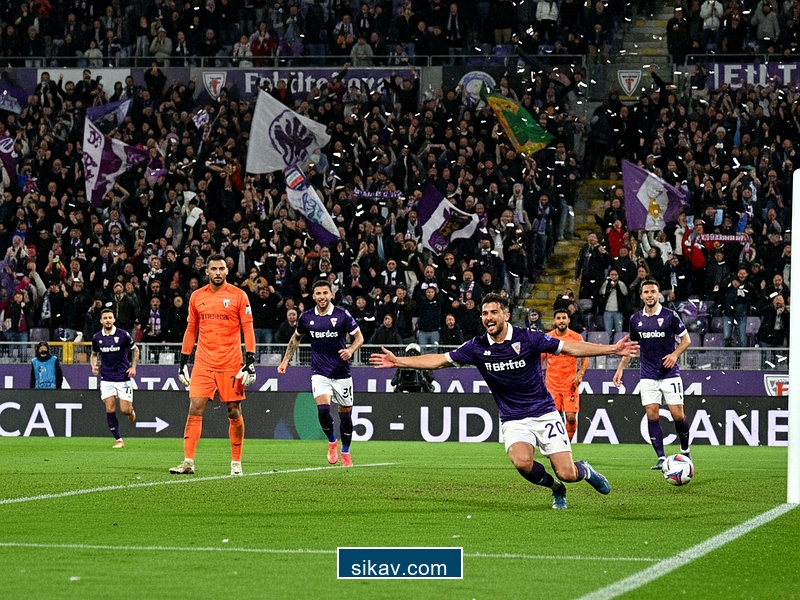
The scoreboard at the Artemio Franchi read 5-1, a jagged neon testament to a Sunday afternoon drubbing. To the casual observer scanning the highlights, the narrative is simple: Udinese goalkeeper Maduka Okoye had a nightmare, gifting Fiorentina an opener that cracked the game open like a stale walnut. But to reduce this performance to a goalkeeping howler is to willfully ignore the tectonic shift occurring in Tuscany. Raffaele Palladino is not merely winning games; he is rewriting the DNA of a club that has spent three years addicted to beautiful, tragic failure.
We are watching the death of the "possession for possession’s sake" dogma that haunted Florence under Vincenzo Italiano, and the birth of something far more predatory. The dismantling of Udinese was not a fluke fueled by errors; it was a manifesto of vertical football. The question is no longer whether Fiorentina can compete for Europe, but whether this specific brand of controlled aggression is the sustainable future of Calcio.
The Ghost of Gasperini and the Evolution of Style
To understand what Palladino is building, one must look at his pedigree. Having cut his managerial teeth at Monza, Palladino is often lazily categorized as a disciple of the Gian Piero Gasperini school—heavy man-marking, lung-bursting wing-backs, and a back three. Yet, what we saw against Udinese was an evolution, not an imitation.
Under Italiano, Fiorentina often played with a suicidal high line, dominating 65% of the ball only to lose 1-0 to a counter-attack. It was romantic, but fragile. Palladino has injected a dose of cynical pragmatism into the Viola bloodstream. Against Udinese, Fiorentina did not obsess over lateral passing. When they won the ball—often through the relentless hounding of Edoardo Bove and Yacine Adli—the first look was forward. This is "verticality" in its purest form.
The 5-1 scoreline reflects a tactical flexibility that was previously absent. Palladino shifts fluidly between a 3-4-2-1 and a 4-2-3-1, confusing opposition marking schemes. Udinese, a team known for physical resilience and a low block under Kosta Runjaic, found themselves pulled apart not by intricate triangles, but by direct, piercing transitions. The spaces Palladino’s system creates for the trailing midfielders suggest a manager who creates structures to isolate defenders, rather than just hoping for individual brilliance.
The Kean Renaissance: System Over Sentinel
Perhaps the greatest indictment of the previous regime—and the greatest compliment to the current one—is the resurrection of Moise Kean. For years, Kean was European football’s lost boy, a wanderer with talent but no tactical home. Critics argued he lacked the hold-up play to be a lone striker or the discipline to be a winger.
Palladino ignored the noise and built a framework that masks Kean's deficiencies while weaponizing his explosive traits. In this system, Kean is not asked to be a static pivot like Luca Toni or an elegant false nine like Stevan Jovetić. He is asked to be a battering ram. The manager demands early balls into the channels, utilizing Kean’s physicality to stretch defenses vertically.
Against Udinese, Kean didn't just score; he terrorized. This is significant because it highlights a managerial philosophy centered on player profiling rather than forcing square pegs into round tactical holes. By simplifying Kean’s role, Palladino has unlocked a 20-goal-a-season potential that Juventus and Everton failed to extract. This isn't luck; it's elite man-management.
The Midfield Metronome: Abandoning the Regista Cult
For a decade, Italian football has fetishized the regista—the deep-lying playmaker. Fiorentina has historically been obsessed with this role, from Pizarro to Torreira to Arthur Melo. Palladino has largely abandoned the need for a singular architect in favor of a dual-piston engine.
The pairing of Yacine Adli and Edoardo Bove (or Danilo Cataldi) represents a shift toward "total midfielders." Against a physical Udinese side, the midfield battle wasn't won by passing accuracy; it was won by intensity and vertical vision. Adli, cast off by Milan, operates with a freedom here that Stefano Pioli never granted him. He is allowed to take risks.
This risk-tolerance is crucial. The opening goal, while an Okoye error, came from pressure. Palladino’s side presses in bursts—specifically targeting the opposition’s weakest ball-handler. It is a data-driven press, conserving energy for specific triggers rather than the blanket "Gegenpress" that often left Italiano’s side gassed by the 70th minute. The sustainability of this project lies in this energy management. They are working smarter, not just harder.
"Beauty in Florence is a requirement, not a request. But for the first time since the Paulo Sousa era, the beauty feels dangerous rather than decorative."
The Defensive Hybrid: A Solvable Puzzle?
If there is a skepticism to harbor regarding this project, it lies in the defense. The transition from a back four to a hybrid back three requires immense tactical intelligence from the wide center-backs. Lucas Martínez Quarta and Pietro Comuzzo are often left in one-on-one situations that would terrify lesser defenders.
However, the introduction of David de Gea has provided a psychological floor that cannot be overstated. While the Spaniard had little to do against Udinese compared to other weeks, his mere presence calms a backline that was historically prone to panic. Palladino knows his high-risk vertical style exposes the defense, so he compensated by bringing in a goalkeeper whose shot-stopping ability can erase tactical leaks. It is a calculated gamble: we will concede chances, but our keeper is better than your striker.
Sustainability vs. The "Purple Haze"
History serves as a warning for Fiorentina fans. In 2015, Paulo Sousa led the Viola to the top of the table playing mesmerizing football, only for the league to figure out his system by January. Is Palladino walking the same path?
The evidence suggests otherwise. Sousa’s system relied on a specific rhythm of possession. Palladino’s approach is chameleon-like. They can suffer without the ball (as seen in matches against Lazio or Milan) and strike on the counter, or they can dismantle a smaller team like Udinese with sustained pressure. This adaptability is the hallmark of a Champions League contender, not just a mid-table overachiever.
Furthermore, the depth of the squad is finally being utilized correctly. The integration of Andrea Colpani and Lucas Beltrán into pockets of space behind Kean creates a "box midfield" overload that Serie A defenses are struggling to track. When Udinese dropped deep, Fiorentina didn't cross blindly; they overloaded the central zones, forcing the defense narrow before switching play. That is sophisticated coaching.
The Verdict
The 5-1 thrashing of Udinese will be remembered for the goals, but the real story is the geometric precision of the setup. Raffaele Palladino has taken a squad built for a different era and repurposed it into a modern, vertical machine. He has replaced the anxiety of the Italiano era with a confident arrogance.
This is not a project reliant on the stars aligning. It is built on pressing triggers, vertical passing lanes, and physical dominance. The road to the Champions League is long, and the traditional powers of the North will eventually stabilize, but Florence finally has a manager who understands that in modern football, control is an illusion—chaos is the ladder. And right now, nobody is climbing it faster than the Viola.