
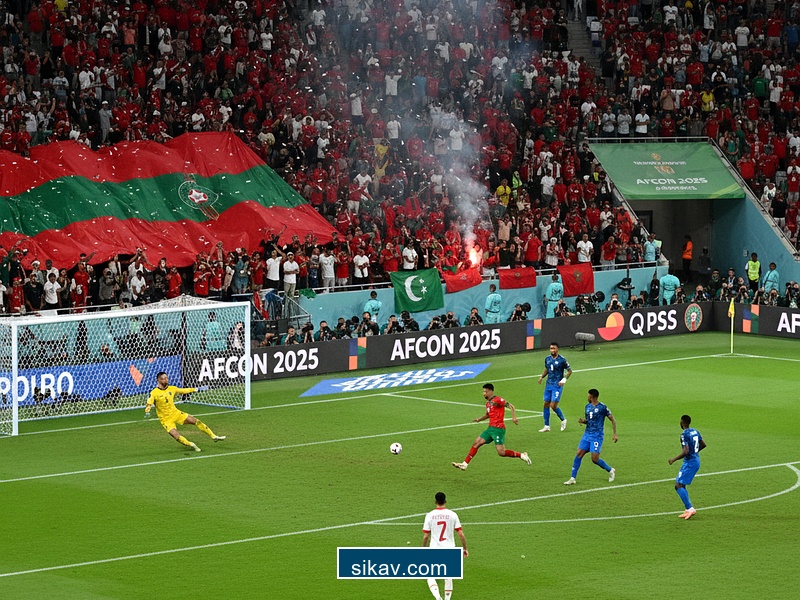
The lights at the Prince Moulay Abdellah Stadium have dimmed, the pyrotechnics of a spectacular opening ceremony have drifted into the Rabat night, and the hysteria of the home crowd has settled into a hum of satisfaction. Morocco 2, Comoros 0. On paper, it is a routine dispatching of a plucky underdog by the continent’s supreme heavyweight. But to view this merely as a regulation win is to misunderstand the architectural overhaul occurring within Moroccan football.
Walid Regragui is not building a team to entertain you. He is building a machine designed to strangle the romance out of the Africa Cup of Nations.
For decades, the Atlas Lions were the poets of African football—technically gifted, aesthetically pleasing, and mentally fragile. They would weave intricate tapestries of passing only to be physically bullied by Egypt or Cameroon in the knockout stages. The ghost of 1976—their solitary continental triumph—has hung over the federation like a shroud. What we witnessed in this tournament opener against Comoros was not just a victory; it was the ratification of a philosophical pivot that began in Qatar.
The Death of the Artist, The Birth of the Pragmatist
The narrative surrounding Regragui often centers on "vibes"—the familial atmosphere, the mothers in the stands, the niya (intention/faith). This is a lazy reduction of a tactically astute pragmatist who has studied the modern European game and realized that possession without penetration is suicide.
Against Comoros, Morocco did not seek to dazzle. They sought control. In the 2022 World Cup, Morocco averaged 32% possession, thriving on a low block and transitions. The skepticism entering AFCON 2025 was valid: could a counter-attacking unit transition into a dominant, ball-playing protagonist? This result suggests yes, but not in the way purists expected.
Regragui has seemingly adopted a hybridized Ancelotti-esque approach. The team shape against Comoros fluctuated between a 4-1-4-1 and a 2-3-5 in possession, but the tempo was deliberately measured. They baited the Coelacanths into pressing, created artificial space, and struck with vertical efficiency. The BBC noted a "Scott McTominay-style finish" to open the scoring—a reference to a late arrival in the box. This is significant. It indicates a structural discipline where midfielders are instructed to exploit spaces vacated by attackers, rather than occupying the same zones.
"We are not here to play music. We are here to take the trophy. If we win 1-0 every game, I am the happiest man in Africa." — Walid Regragui (Pre-tournament presser context)
This cynicism is their greatest asset. Previous Moroccan sides would have panicked at 0-0 after 30 minutes. This vintage trusts the system. They understand that in tournament football, defensive solidity is the only currency that doesn't fluctuate.
The Industrialization of Success
To attribute this 2-0 victory solely to the eleven men on the pitch is to ignore the colossal "Project" engineered by the Royal Moroccan Football Federation (FRMF) and its president, Fouzi Lekjaa. This result is the dividend of a fifteen-year investment strategy that is unmatched in African history.
The Mohammed VI Football Academy, inaugurated in 2009, was the foundation. But the current phase is about the weaponization of the diaspora combined with domestic infrastructure. Regragui is not just a coach; he is the face of a sovereign wealth fund project applied to sport. The team playing Comoros featured a seamless blend of European-born talent and local academy graduates. This integration used to be a source of friction in the dressing room (the Zmagria vs. Botola divide). Under Regragui, that social fracture has been healed.
Consider the sustainability of this model. Unlike the golden generations of Ivory Coast (2006-2014) or Nigeria (1994-1998), which relied on serendipitous clusters of talent, Morocco has industrialized the production line. If a winger is injured, the system produces a replacement with identical tactical DNA. The "Project" demands that the national team functions like a high-end European club side.
The Full-Back Dilemma
Despite the comfortable scoreline, tactical fissures remain. The reliance on Achraf Hakimi and Noussair Mazraoui (or their deputies) as primary playmakers is a double-edged sword. Against Comoros, much of the play was funnelled wide. While effective against a minnow, this predictability could be exploited by tactically disciplined sides like Senegal or a resurgent Nigeria.
Regragui’s philosophy relies heavily on full-back inversion to overload the midfield. When it works, it creates numerical superiority. When it fails, it leaves the center-backs exposed to rapid transitions. Comoros had moments where a higher-quality pass could have embarrassed the Moroccan high line. The manager knows this. His sideline demeanor wasn't one of celebration, but of constant, agitated correction.
Contextualizing the Contenders
ESPN and the BBC have rightfully placed Morocco at the top of the Power Rankings. However, being the host nation is often a poisoned chalice. The pressure in Rabat is suffocating. The spectacular opening ceremony raised the emotional temperature, and for many teams, that adrenaline leads to burnout.
We must look at the historical data. The last host nation to win the AFCON was Egypt in 2006. Since then, hosts have crumbled under the weight of expectation or logistical distractions. Regragui’s primary job is not tactics; it is emotional regulation. The 2-0 win was professional, devoid of the emotional rollercoaster that defined Cameroon’s campaign in 2021 or Ivory Coast's chaotic run in 2023.
The Verdict
Is this result sustainable? Absolutely. In fact, it is terrifyingly sustainable. Morocco did not play at 100% capacity, and that is the point. They managed the game, conserved energy for the humid conditions expected in the later stages, and secured the three points.
The critics will call for more flair. They will ask to see the dazzling dribbles associated with North African football. But Regragui has looked at the history books and realized that "beautiful losers" are still losers. By stripping the team of its vanity and instilling a cold, ruthless efficiency, he has created a squad that doesn't need to play well to win.
The Atlas Lions have finally shed their fur for armor. The rest of Africa should be worried—not because Morocco is unplayable, but because they have finally learned how to be boring.