
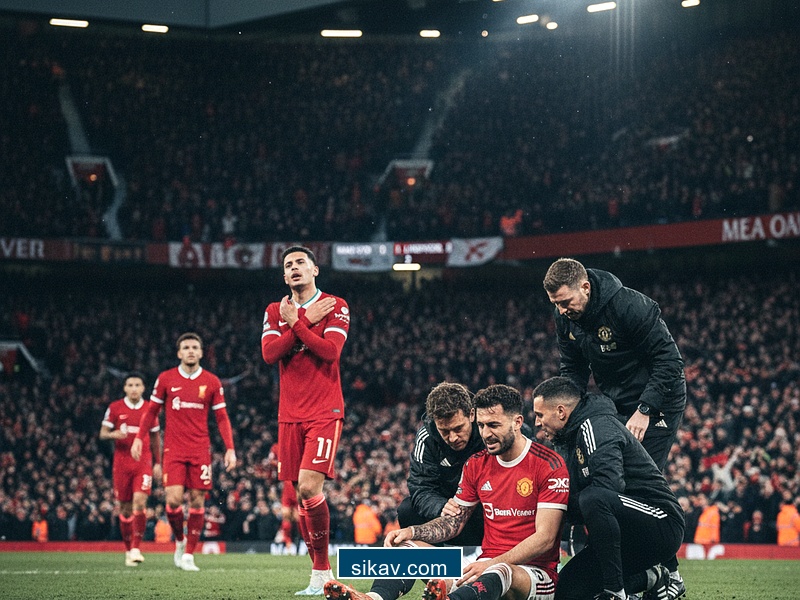
The sight of Bruno Fernandes limping off the turf is not merely an injury update; it is a structural indictment. For the better part of five years, the Portuguese magnifico has been the duct tape holding a crumbling architecture together. He plays every minute, presses every blade of grass, and creates something out of nothing when the system fails to provide solutions.
Now, coupled with Kobbie Mainoo’s absence in a demoralizing defeat, the curtain has been pulled back. Manchester United is not a project in transition; it is a project in denial.
We are told constantly to "trust the process," yet the evidence suggests the process itself is flawed. A manager’s philosophy is usually visible even in defeat—think of Marcelo Bielsa’s Leeds or the early, erratic days of Jurgen Klopp’s Liverpool. You could see the blueprint even when the house collapsed. At Old Trafford, the blueprint appears to be chaos.
The Myth of "The Best Transition Team"
Erik ten Hag famously declared his ambition to make United the "best transition team in the world." It was a quote that should have set alarm bells ringing in the tactical analysis departments of every rival club. In modern football parlance, relying on transition is tantamount to admitting you cannot control a game.
Control is the currency of champions. Manchester City under Pep Guardiola or Arsenal under Mikel Arteta suffocate opponents. They rest with the ball. United, conversely, treats the football like a hot potato. By designing a system that relies on high turnovers and vertical sprints, the manager has created a basketball match on grass. It is end-to-end, frantic, and inherently exhausting.
"When you play chaos football, you need superhuman athletes. When those athletes break, you are left with a gaping hole in the middle of the park that you could drive a bus through."
This tactical choice explains the injury crisis better than bad luck ever could. The physical load placed on midfielders in this system is unsustainable. Mainoo, a teenager still physically maturing, has been asked to cover the ground of two men because the tactical setup leaves the midfield mostly vacant. The gap between the defensive line (often dropping deep due to a lack of pace) and the pressing forward line creates a chasm. Mainoo and Fernandes have been sprinting through this no-man's-land for months. Their bodies haven't failed; the system failed their bodies.
The Statistical Reality of the "Doughnut" Formation
Deep-dive analytics expose the rot. United consistently concedes a volume of shots comparable to relegation-threatened sides. This isn't a defensive error; it is a structural feature. The team often adopts a 4-1-5 or 3-1-6 shape in attack, leaving a solitary pivot exposed to counter-attacks.
Historically, Sir Alex Ferguson’s teams were adventurous, but they were built on the pragmatic steel of Roy Keane or Michael Carrick, who understood when to hold position. The current iteration ignores the concept of "rest defense"—the positioning of players while you have the ball to prevent counters. Without Fernandes to trigger the press or Mainoo to shuttle the ball, the team reverts to a disjointed collection of individuals who look like strangers.
The Liverpool Contrast: Intent vs. Panic
While United mourns the loss of its only reliable engines, the news cycle offers a brutal contrast in competence: Liverpool’s monitoring of Alexander Isak. This rumor, regardless of whether it materializes, highlights a fundamental difference in how serious clubs operate.
Liverpool identifies profiles. Isak is a pressing monster, comfortable in tight spaces, capable of playing across the front three, and statistically elite at progressive carries. He fits a specific tactical requirement. If Liverpool moves for him, it is because he is a cog that fits a machine.
United’s recruitment and squad management, by comparison, feels reactive. They buy names and hope the manager can shoehorn them into a non-existent philosophy. The reliance on Mainoo—an academy graduate—to fix a midfield that has seen hundreds of millions of pounds in investment is institutional negligence. Mainoo should be the cherry on top, not the structural beam holding up the roof.
| Strategic Pillar | Manchester United's Reality | Elite Standard (City/Liverpool/Arsenal) |
|---|---|---|
| Midfield Structure | High-risk, empty central zones ("The Doughnut") | Compact, control-oriented, box midfields |
| Player Load | Maximum exertion every match due to chaos | "Resting with possession" reduces sprints |
| Recruitment | Reactive to market availability | Proactive to tactical fit (e.g., Isak interest) |
| Youth Integration | Necessity (Mainoo as savior) | Integration (Lewis/Bradley as rotation) |
The Pedri Warning
We have seen this movie before. Barcelona ran Pedri into the ground during his breakthrough season, playing him in over 70 matches for club and country. The result was a recurring hamstring issue that stalled the development of a generational talent. Kobbie Mainoo is on that same trajectory.
By failing to sign a mobile, astute defensive midfielder to partner him—Casemiro’s legs have clearly gone, and Eriksen is a luxury player for specific game states—United has forced a boy to do a man’s heavy lifting. When the philosophy demands high-octane pressing but the recruitment provides aging legs, the youngest player carries the burden. The injury was not a surprise; it was a mathematical certainty.
Sustainability is Non-Negotiable
The loss itself is irrelevant. Teams lose games. What matters is the manner of the failure. Without Fernandes, United lacked a brain. Without Mainoo, they lacked a heart. But a billion-pound squad should not be rendered impotent by two injuries.
Look at Arsenal without Martin Ødegaard. They suffer, yes, but the structure remains. They fall back on a drilled defensive shape. United, stripped of individual brilliance, reverts to panic. This suggests that Ten Hag has not instilled a philosophy of play, but rather a philosophy of reliance.
The "project" is a mirage. You cannot build a skyscraper on a swamp. Unless there is a radical shift away from "chaos ball" toward controlled possession and structural discipline, the injuries will continue, the losses will mount, and the gap between Manchester United and the elite will calcify into permanence.
Liverpool worrying about Isak is a team looking to refine a Ferrari. United losing Mainoo is a driver realizing the wheels have fallen off the clown car. The manager can point to injuries all he wants, but when your entire system collapses because a 19-year-old isn't there to save it, the problem isn't the injury list. The problem is the manager.