
By The Scout’s Eye
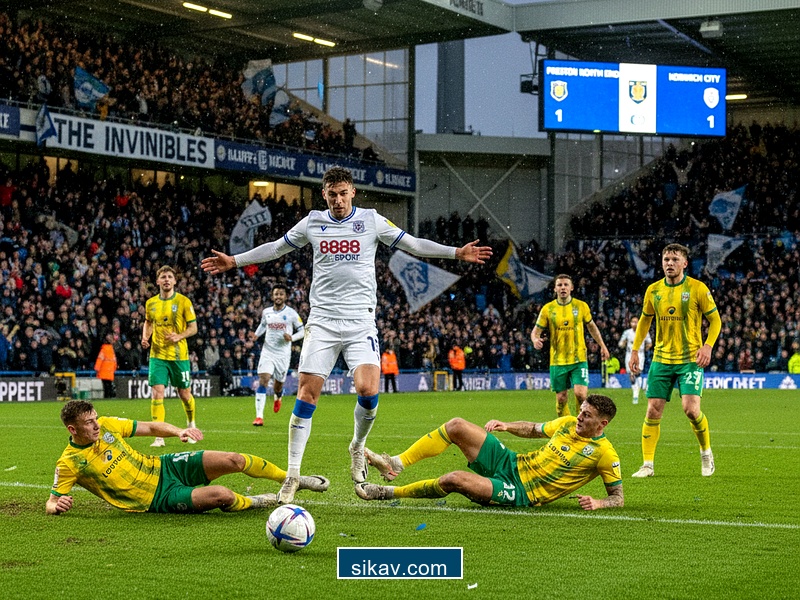
There is a specific, sickening silence that falls over a technical area when a structure breaks down in the ninety-fourth minute. It isn’t the noise of the crowd that registers; it’s the sudden, chaotic shattering of ninety minutes of tactical discipline. The 1-1 draw between Preston North End and Norwich City at Deepdale wasn't just a share of the spoils; it was a seminar on cognitive fatigue and the predatory instincts of Will Keane.
From the gantry, you stop watching the ball around the 85th minute. You watch the lungs. You watch the micro-movements of the centre-halves. You look for the player whose shoulders have dropped an inch, whose scanning frequency has slowed from every four seconds to every ten. That is where the game is lost. Norwich City didn’t lose two points because of bad luck; they lost them because they failed the physical exam of Championship management.
The Fallacy of Passive Possession
For large swathes of this contest, Norwich exhibited what we in the scouting business call "sterile domination." It looks pretty on the heatmap—lots of lateral movement, high pass completion rates in the middle third—but it lacks the vertical incision required to kill a game. When you scout a team like Norwich, you look at their Rest Defence (the structure they maintain while attacking).
Throughout the second half, Norwich’s full-backs were inverting, clogging the central channels to prevent Preston’s transition. It worked, until the legs went. The Championship is a league of attrition, not aesthetics. Deepdale, with its tight pitch and hostile acoustics, demands a physical robustness that goes beyond mere strength. It requires "game intelligence" under duress.
The "cruellest scenario" alluded to in the post-match discourse isn't just about the timing of the goal; it’s about the failure of game management. When a team leads 1-0 away from home, the objective shifts from progression to territorial denial. Norwich failed to manipulate the space. Instead of pinning Preston back into their own corners, they invited pressure, retreating into a low block that they lacked the aerial dominance to sustain.
Will Keane: The Anatomy of a Raumdeuter
Let’s talk about Will Keane. If you look purely at his sprint metrics, he won’t blow you away. He isn’t stretching defences with electric pace like a traditional number nine. But Keane possesses an elite pedigree, honed in the Manchester United academy, which teaches a specific type of spatial awareness that is rare in the second tier.
Keane operates effectively as a Championship Raumdeuter—a space investigator. Watch the replay of the equaliser, but ignore the ball. Watch Keane’s head. While the Norwich centre-backs are ball-watching, fixated on the delivery, Keane is scanning. He checks his shoulder three times in the five seconds leading up to the goal. This is the "unseen" work that separates a goalscorer from a striker.
"In the dying moments, the brain screams for oxygen, and the first thing to go is peripheral vision. Defenders develop tunnel vision. Keane exploits that blind spot. He doesn't move to where the ball is; he moves to where the defender isn't looking."
When the ball eventually drops, Keane isn't reacting to the flight of the leather; he has already calculated the trajectory and adjusted his body shape. He opens his hips, lowering his centre of gravity to ensure that any contact is clean. It’s a biomechanical efficiency that allows him to generate power with minimal backlift—a nightmare for goalkeepers who rely on visual cues to set their feet.
The Collapse of the Norwich Pivot
Tactically, the equaliser originated from a breakdown in the Norwich midfield pivot. In a standard 4-2-3-1 or 4-3-3 defensive phase, the defensive midfielder's job in stoppage time is to screen the "Zone 14" (the area just outside the penalty box) and win second balls.
Preston, recognizing the fatigue in the Canaries' legs, abandoned their intricate build-up play for direct verticality. They bypassed the midfield press entirely. This creates a "broken field" scenario. The ball is pumped long, chaos ensues, and structure dissolves. Norwich’s midfielders failed to compress the space between themselves and their defensive line.
This separation—often no more than five or six yards—is fatal. It allowed Preston to win the knockdown and recycle possession in a dangerous area without immediate pressure. A disciplined unit compresses that space, suffocating the opposition. Norwich left the door ajar, and Keane kicked it down.
Deepdale’s Dark Arts and the Psychological War
We must credit Preston North End’s "game state" management. There is a grittiness to this PNE side that reflects the history of the club. They understand that in the Championship, technical inferiority can be neutralized by disrupting the opponent's rhythm.
Throughout the final ten minutes, watch the Preston midfielders. They engage in what coaches call "rotational fouling" or tactical disruption—not enough to get sent off, but enough to stop Norwich from establishing a counter-attacking rhythm. They turn the game into a series of set-piece duels, which statistically favours the home side with the crowd at their back.
The "Ex-Rangers manager" narrative mentioned in the press highlights the immense pressure in the dugout. Football management is cruel because it relies on the split-second decisions of exhausted athletes. But a manager’s job is to drill habits so deep that they survive exhaustion. Norwich’s habits crumbled. They stopped clearing their lines; they stopped squeezing the pitch. They played with hope rather than certainty.
The Verdict: Points Won vs. Points Spilled
Historically, teams that concede late equalisers suffer a "hangover" effect in their next fixture. The psychological blow of losing two points in stoppage time is statistically more damaging than a comprehensive 3-0 defeat. It breeds mistrust in the defensive system. Defenders start to doubt their positioning; goalkeepers hesitate on crosses.
For Preston, this 1-1 is gold dust. It validates the manager’s insistence on playing until the final whistle—a cliché, yes, but one grounded in aerobic capacity and mental resilience. Will Keane’s goal wasn’t a fluke; it was the logical conclusion of a tactical battle where one team tried to hide from the clock, and the other decided to punch it in the face.
In the cold light of analysis, Norwich City were technically superior but tactically naive. Preston were rugged, disjointed, but biomechanically relentless. In the Championship, the latter often eats the former for breakfast.