
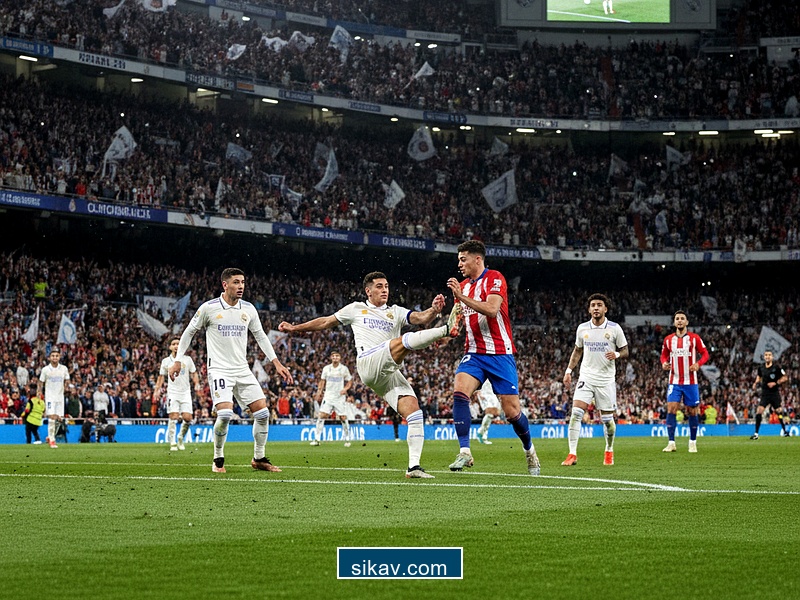
The teamsheet for Real Madrid against Sevilla has dropped, and while the casual observer sees a list of names, the trained eye sees the culmination of a decade-long architectural project. We are looking at a lineup that doesn't just aim to win a La Liga fixture; it aims to rewrite the tactical dogma that defined the club’s identity for the last twenty years.
For too long, the shadow of the early 2000s Galácticos has loomed over the Santiago Bernabéu. It was a spectre of glamour over substance, a marketing strategy masquerading as a football team. But looking at the confirmed XI to face Sevilla today, one thing is violently clear: the Florentino Pérez of 2025 has finally learned the lesson that the Florentino Pérez of 2003 ignored to his peril. This isn't a collection of sticker-album favorites; it is a ruthless, synchronized machine.
The Ghost of Claude Makélélé
To understand the genius of today's midfield selection, we must revisit the summer of 2003. Real Madrid sold Claude Makélélé to Chelsea to fund the vanity signing of David Beckham. Zinedine Zidane famously quipped, "Why put another layer of gold paint on the Bentley when you are losing the entire engine?"
Fast forward to 2025. The inclusion of Aurélien Tchouaméni and Eduardo Camavinga (or the tactical deployment of Federico Valverde in that hybrid role) is the direct antithesis of the Beckham era. Today's lineup features a midfield that is physically imposing, technically elite, and defensively responsible.
Where the 2003 side crumbled because Guti was forced to play defensive midfield against disciplined sides, this 2025 iteration suffocates opponents. Valverde is not just an engine; he is the modern interpretation of the "box-to-box" midfielder, possessing the lung capacity of Edgar Davids but the ball-striking technique of Steven Gerrard. Sevilla’s midfield block, traditionally gritty and compact, faces a distinct problem: they cannot press Madrid because Madrid’s midfield can bypass the press with a dribble (Camavinga) or a 60-yard switch (Valverde/Tchouaméni).
Bellingham vs. Zidane: The Evolution of the Number 5
Seeing Jude Bellingham in the lineup inevitably draws comparisons to the man whose number 5 shirt he inherited. However, the nostalgia merchants get this wrong. Zidane was art; he operated in moments of pause, slowing the game down to his heartbeat. Bellingham is heavy metal. He operates at a cadence that simply didn't exist in 2005.
In the confirming lineup, Bellingham’s role is likely fluid, drifting between a false nine and a traditional 10. This tactical flexibility is what separates this era from the Galácticos. When Luis Figo and Zidane played, they occupied fixed zones. If Figo drifted left, the structure collapsed. If Bellingham drops deep, Vinícius Júnior or Kylian Mbappé instantly occupy the vacated space. It is total football played by athletes who are faster and stronger than their predecessors.
"The 2003 Galácticos were a team of soloists waiting for their turn to sing. The 2025 squad is a choir that knows how to scream."
The Death of the 'BBC' and the Rise of Liquid Attack
For a decade, we measured everything against the BBC (Bale, Benzema, Cristiano). That trio, specifically during the 2013-2018 Champions League runs, was built on vertical devastation. They didn't need the ball; they just needed three seconds of chaos. Cristiano Ronaldo’s 2011/12 season, where he scored 46 league goals, was the peak of this "shock and awe" football.
Today's frontline is fundamentally different. With Vinícius and Mbappé starting, we aren't seeing counter-attacking specialists; we are seeing possession dominators who can also sprint at 35 km/h. The BBC often left the midfield exposed—Ronaldo and Bale rarely tracked back past the halfway line. The current crop presses. The confirmed lineup suggests a high line of engagement that would have given the 2014 team an aneurysm.
Sevilla’s defense, which relies on maintaining a low block and frustrating the opponent, is ill-equipped for this. You could frustrate Ronaldo by cutting off his supply line. You cannot frustrate Vinícius in the same way because he is the supply line. He creates from the touchline, the half-space, and the byline. The dependency has shifted from "feed the scorer" to "everyone is a scorer."
The Defensive Asymmetry: A Post-Ramos Reality
There is a specific irony in playing Sevilla, the club where Sergio Ramos began and eventually returned. For 16 years, Madrid’s defense was defined by the Ramos personality cult: high risk, high reward, emotional leadership. It was effective, but it was chaotic.
The center-back pairing confirmed for today represents the shift from "Hero Ball" to "System Defense." Whether it is Éder Militão, Antonio Rüdiger, or a younger partner stepping in, the defensive logic is closer to the Arrigo Sacchi Milan teams than the delusions of the Pavones era. In the early 2000s, Florentino Pérez tried to pair superstars with academy graduates (Pavones) to save money. It was a disaster that led to leaky defenses.
Now, the defense is arguably the most expensive and structurally sound part of the team. They defend with the ball. By retaining 65% possession (a projected stat based on this lineup against Sevilla’s current setup), the best defense is simply denying Sevilla the opportunity to construct an attack. Pepe and Ramos thrived on last-ditch tackles; this unit thrives on interception and positioning.
Sevilla’s Predicament
We must acknowledge the opponent. Sevilla has historically been the pebble in Madrid’s shoe. The Ramón Sánchez Pizjuán (or even visiting the Bernabéu) brings out a visceral fight in the Andalusians. However, looking at their corresponding lineup, the disparity in athletic conditioning is glaring.
La Liga has evolved. The technical gap between the top and the upper-middle class has narrowed, but the physical gap has widened. Madrid’s lineup is built to play a 90-minute game at a tempo that Sevilla can likely only sustain for 60. The bench options available to Madrid—youth talents like Arda Güler or Endrick—provide a second wave of intensity that 2004 Madrid never had. Back then, if Raul or Ronaldo were tired, the replacements were drastic drop-offs in quality. Today, the replacements are world-class starters in waiting.
The Verdict
This confirmed lineup is a declaration of intent. It is a rejection of the unbalanced celebrity culture of the early 2000s and an evolution beyond the pure counter-attacking reliance of the Mourinho/Ancelotti 1.0 era. It combines the star power of the former with the tactical rigidity of the modern super-club.
Real Madrid vs. Sevilla used to be a clash of styles—aristocracy vs. grit. Today, looking at these names, Madrid brings the grit, the speed, and the aristocracy. If the Galácticos were a Hollywood blockbuster, this team is a documentary on efficiency. And efficiency, unlike glamour, wins trebles.