
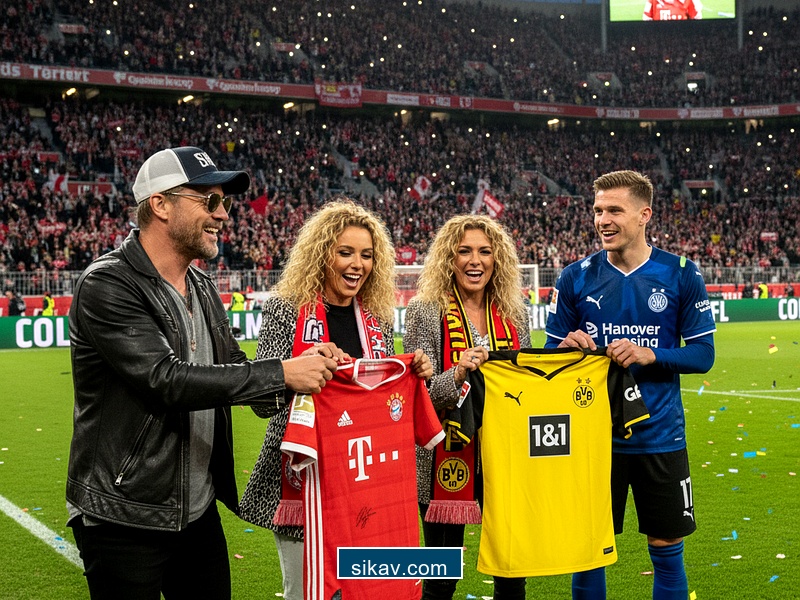
There is a distinct difference between a player who drifts into space by accident and one who occupies it with intent. As a scout, you learn to ignore the ball and watch the hips, the eyes, and the preparatory movement before the reception. Recently, the world of high fashion has been making a series of aggressive runs into the Bundesliga’s technical area. We are seeing A-list celebrities—Rihanna, Bella Hadid, Snoop Dogg—donning German football kits, not as casual fan wear, but as deliberate tactical assets in their wardrobe rotation.
This isn't just "Blokecore." To dismiss it as such is lazy punditry. This is an appreciation of structural integrity and aesthetic discipline. When I analyze why the global elite are reaching for a 1993 Borussia Dortmund fluorescent Nike top or a St. Pauli skull-and-crossbones, I don’t see fashion trends. I see a recognition of the Bundesliga’s superior graphical "shape" compared to its European rivals.
The False 9: Rihanna and the Art of the Dropped Shoulder
Let’s analyze the movement pattern of Rihanna. She operates as a classic False 9—dropping deep into the archives to link play between streetwear and haute couture. When she steps out in a vintage oversized jersey, observe the silhouette. Modern kits are designed for aerodynamic efficiency on athletes with 4% body fat; they are tight, restrictive, and tactically rigid. The vintage Bundesliga kit, however, offers a boxy, robust structure.
"The oversized 90s jersey allows for a lower center of gravity in the visual presentation. It suggests a player who is hard to knock off the ball."
Rihanna understands the "half-spaces." By pairing a heavy, polyester German jersey with high-end accessories, she creates an overload in the midfield of her outfit. Historically, the Bundesliga in the 1990s was a hotbed for experimental design—think of the geometric abstraction on the VfL Bochum kits or the neon boldness of Dortmund. These shirts were loud, abrasive, and structurally sound. Rihanna utilizes this loudness to dictate the tempo of the paparazzi interaction. She isn't wearing the shirt; she is captaining the outfit.
Bella Hadid: The Regista of Retro
Bella Hadid’s approach is different. She plays as a Regista, a deep-lying playmaker operating from the base. Her selection of slimmer, 1970s and 80s inspired Adidas cuts (often associated with Bayern Munich or the West German national team) shows a penchant for technical proficiency over physical dominance.
From a scouting perspective, Hadid values the "first touch." The Adidas trefoil era represents the peak of textile engineering before the synthetic explosion. The cotton-blend fabrics of that era drape differently; they respond to body movement with a fluidity that modern Dri-Fit cannot replicate. Hadid leverages the iconic three stripes on the shoulder to widen her frame, creating an illusion of broader tactical influence. It’s a disciplined, conservative selection that relies on the heritage of the badge rather than the shock value of the color palette.
The St. Pauli Phenomenon: Counter-Pressing the Culture
You cannot scout the Bundesliga’s influence on fashion without addressing the heavy metal football of FC St. Pauli. Wearing a St. Pauli shirt in Hollywood is the sartorial equivalent of a Gegenpress. It is high-intensity, politically charged, and disrupts the opponent's build-up play.
The brown, white, and red color scheme is objectively difficult to pull off. It lacks the royal elegance of Real Madrid white or the safe utility of Manchester United red. Yet, celebrities gravitate toward it. Why? Because the "work rate" of the brand is exceptional. The skull and crossbones is not merely a logo; it’s a signal of intent. It tells the viewer that the wearer understands the unseen work off the ball—the anti-fascist, punk-rock ethos of the Millerntor-Stadion.
When a celebrity wears St. Pauli, they are attempting to inherit the club's "stats"—their grit, their authenticity, and their underdog status—without having to endure a rainy Tuesday night in Bundesliga 2. It’s a loan move for cultural credibility.
Tactical Breakdown: Why Bundesliga Kits Outperform the Premier League
Why are scouts finding these gems in Germany and not England? The Premier League’s aesthetic history is cluttered with over-commercialization. The Bundesliga, conversely, maintained a graphical purity for longer, thanks in part to the cultural affinity for Bauhaus principles—function following form.
Consider the sponsor integration. In the 80s and 90s, German sponsors (chemical giants, local breweries, heavy industry) had logos that were graphically heavy and geometrically sound. They acted as a pivot point for the shirt's design. English sponsors often felt slapped on. A celebrity stylist, acting as the Director of Football, looks for balance. The structural integration of the "Opel" eye or the "Die Continentale" text on Dortmund shirts provides a visual anchor that holds up under the flash of cameras.
Scouting Report: The Fabrication Factor
We must also look at the biomechanics of the textile. The transition from the heavy cottons of the 70s to the shiny, jacquard polyesters of the 90s created two distinct movement patterns in fashion.
- The Heavy Cotton Era (70s-80s): Low elasticity. Requires the wearer to have upright posture. Projects authority and tradition. Seen on "Purist" celebrities.
- The Jacquard Poly Era (90s): High sheen, chaotic patterns woven into the fabric, not printed on top. Catches light aggressively. Projects irony and confidence. Seen on "Trendsetter" celebrities.
The Bundesliga mastered the Jacquard weave. Look at the texture of a vintage Karlsruher SC or Eintracht Frankfurt shirt. The pattern is deep-lying, much like a defensive midfielder screening the back four. It adds complexity without needing to scream.
The Verdict
Celebrities reaching for Bundesliga gear is not a random variance in the data. It is a calculated recognition of superior design philosophy. They are identifying value in the market that casual fans overlook.
The Bundesliga shirt offers a tactical versatility that other leagues lack. It can play high up the pitch (high fashion weeks) or grind out a result in the low block (streetwear). As a scout, I look for longevity and adaptability. The current crop of vintage German kits being rotated by the Hollywood elite demonstrates elite durability. They have survived the wash cycle of history and retained their structural shape.
We are witnessing a shift in formation. The suit is dead; the streetwear hoodie is tired. The vintage football kit, specifically the disciplined eccentricity of the German tiers, is the new playmaker. It requires no introduction, holds the ball up well under pressure, and finishes clinically in the Instagram comments section.