
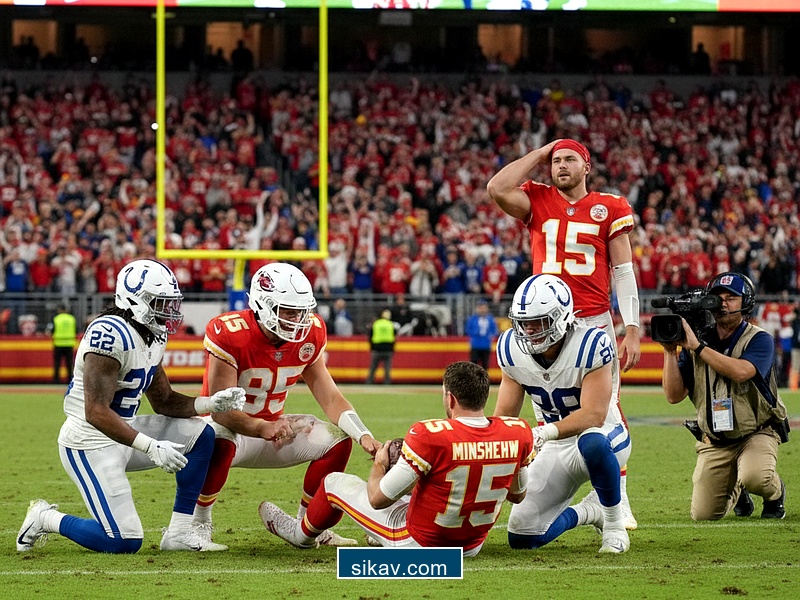
The NFL, in its cruelest moments, is not a test of talent but a test of attrition. Sunday’s revelation that Gardner Minshew likely suffered a torn ACL against the Tennessee Titans is more than a roster notification; it is a structural stress test on the Kansas City Chiefs dynasty that we haven't seen since the pre-Mahomes era. With Patrick Mahomes presumably sidelined—necessitating Minshew’s start in the first place—and the "Mustache" now felled by the turf monster, the Chiefs are staring down the barrel of a reality that has doomed lesser franchises: The Third-String Abyss.
We are no longer discussing whether Andy Reid is an offensive genius. We are about to find out if he is a miracle worker. The baton now passes to Chris Oladokun, a name that, until Sunday, existed primarily on practice squad transaction wires. This situation demands we look past the immediate box score and contextualize this collapse against the history of contenders forced to dig this deep into their depth chart.
The Ghost of A.J. Feeley and the 2002 Eagles
To understand the precipice Kansas City stands upon, we must rewind 22 years to a different Andy Reid sideline. The year was 2002. The Philadelphia Eagles were the class of the NFC, led by Donovan McNabb. When McNabb broke his ankle in November, the football world drafted Philadelphia's obituary. Reid turned to Koy Detmer, who promptly dislocated his elbow. Enter A.J. Feeley.
Feeley was a fifth-round pick with limited pedigree. Yet, Reid simplified the geometry of the field. He stripped down the West Coast offense, removing the deep drop-backs that required complex secondary reads, and instituted a rhythm-based, three-step drop game that protected the quarterback and the ball. The Eagles went 4-0 down the stretch with Feeley, securing the top seed. Reid did it again in 2006, resurrecting Jeff Garcia’s career after McNabb tore his ACL, leading that squad to a playoff victory.
This is the historical precedent Chiefs fans must cling to. Reid has a proven track record of quarterback alchemy. However, there is a distinct difference between the 2002 Eagles and the 2024 Chiefs. That Eagles team possessed a defense that ranked second in the league in points allowed (10.5 per game in that Feeley stretch). They could win a game 13-10. The modern NFL, and specifically the Chiefs' current defensive configuration, does not offer the same margin for error. Minshew was a chaotic but capable bridge; he threw for yards, he scrambled, he kept the play alive. Oladokun is a complete cipher.
The "Curtis Painter" Scenario
The darker historical parallel—and the one that keeps general managers awake at night—is the 2011 Indianapolis Colts. For a decade, Peyton Manning was the system. His brain was the offensive coordinator; his arm was the engine. When neck surgery sidelined him, the Colts didn't just regress; they collapsed into a black hole. Kerry Collins failed. Curtis Painter was a disaster. Dan Orlovsky tried to salvage the wreckage, but a perennial 12-win team plummeted to 2-14.
That Colts team exposed a fatal flaw in roster construction: the "Star-Dependent Ecosystem." The Chiefs have built everything around the assumption of elite quarterback play. The wide receiver routes are longer developing, relying on Mahomes' ability to extend plays or Minshew’s ability to improvise. A third-string quarterback, typically operating with limited reps, relies on timing and structure—two things that vanish when an offensive line is fatigued in Week 16.
If Oladokun cannot execute the complex "rub" routes and option concepts that define the Reid/Nagy playbook, the offense becomes static. We saw this with the 2019 Pittsburgh Steelers. When Ben Roethlisberger went down, Mason Rudolph and Duck Hodges took over. The Steelers' offense didn't just get worse; it ceased to function as a professional unit, relying almost entirely on defensive turnovers to score.
Tactical Theory: The Shrinking Playbook
What happens tactically against the Broncos next week? We are likely to see a regression to "1990s Football." With Minshew, Reid could still call RPOs (Run-Pass Options) and full-field reads. With Oladokun, the field gets cut in half.
Expect to see:
- Half-Field Floods: Giving the QB one side of the field to read (High-Low) to eliminate the danger of cross-field interceptions.
- Six-Man Protections: The tight end will stop running routes and start chipping defensive ends. Travis Kelce’s production may plummet simply because he is needed to block to keep Oladokun upright.
- Heavy Run Personnel: The use of 12 (1 RB, 2 TE) or even 13 personnel to force the Broncos into base defensive packages, simplifying the coverage looks.
The danger here is predictability. Defensive coordinators in the NFL are sharks. If they know you can't throw outside the numbers or deeper than 15 yards, they will compress the field, bringing safeties into the box. This suffocates the run game, creating a vicious cycle of three-and-outs.
The Valuation of the "Next Man Up"
It is easy to dismiss Chris Oladokun as a warm body, but his journey from South Dakota State to the biggest stage in sports is significant. He threw for over 3,000 yards in his final college season, showing mobility and arm talent. However, the jump from the FCS to staring down an NFL pass rush is the widest gap in professional sports.
Historically, third-string quarterbacks who succeed usually fall into the "Grizzled Veteran" category—think Matt Moore starting for the Chiefs in 2019 when Mahomes dislocated his knee. Moore had seen every coverage the league had to offer. Oladokun has not. He is effectively a rookie in terms of game speed.
The injury to Minshew robs the Chiefs of experience. Minshew had 37 career starts entering this season. He knew how to manage a huddle. Oladokun will be managing his own adrenaline as much as the clock. The loss to the Titans was bad, but the loss of the "floor" that Minshew provided is catastrophic. Minshew guarantees you a chance to compete; Oladokun guarantees variance. That variance could be a miraculous debut, but history suggests it is more likely to be a turnover-filled struggle.
The Playoff Ramifications
This injury creates a power vacuum in the AFC. The Chiefs have long benefited from an aura of invincibility. Opponents press, make mistakes, and beat themselves because they fear the inevitability of Kansas City. That aura died on the field with Minshew’s knee.
If the Chiefs drop the game to the Broncos—a very real possibility with a QB3—seeding shuffles. But more importantly, the psychological armor is cracked. Teams like the Bills and Ravens, who have smashed their heads against the Chiefs' wall for years, now see a team held together by duct tape. The 2000 Baltimore Ravens proved you can win a Super Bowl with Trent Dilfer, but they had Ray Lewis and Rod Woodson. The Chiefs are asking Chris Oladokun to be the pilot of a Ferrari with a flat tire.
The coming week will be the defining moment of the 2024 season. Not just for the standings, but for the legacy of Andy Reid. If he can manufacture a functional offense out of these spare parts, build a statue. But if the wheels come off, we will look back at Minshew’s ACL tear not just as an injury, but as the moment the dynasty finally ran out of luck.