
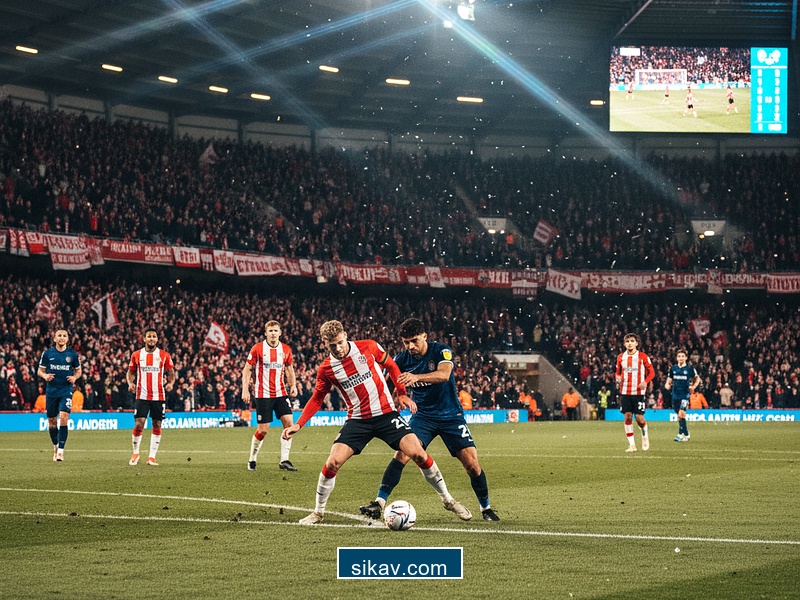
The scoreboard at the Eco-Power Stadium didn’t just reflect a defeat; it displayed a capitulation. A 1-5 home loss is rarely a tactical accident. It is almost always a structural failure combined with a psychological collapse. Having spent two decades watching defensive lines hold or fold, I can tell you that the difference between a narrow loss and a rout lies in the unseen work: the scanning, the verbal triggers, and the body language during transition.
When Plymouth Argyle dismantled Doncaster Rovers, we witnessed two teams operating in different temporal realities. Plymouth, under Wayne Rooney and coached on the day by a "delighted" Tom Cleverley, played in the future—anticipating where the ball would be. Doncaster, currently mired in what Owen Bailey rightly calls a "wretched run," were stuck in the past, reacting to events that had already bypassed them.
The Mechanics of the Tolaj Hat-Trick
A hat-trick is the headline, but for a scout, the goals are merely the receipt for work done earlier in the possession chain. Tolaj’s performance wasn't just about finishing; it was a masterclass in blind-side movement. In modern forward play, the most dangerous space is not in front of the defender, but specifically in the "channel" between the center-back and the full-back, just outside the defender’s peripheral vision.
throughout the ninety minutes, Tolaj exploited Doncaster’s inability to screen their defensive line. When the ball went wide, Tolaj didn't run to the near post immediately. He utilized double movements—a check away to drag the center-back out of position, followed by a dart across the face of goal. This is high-level spatial awareness.
Doncaster’s defenders were guilty of "ball-watching." In coaching terms, their scanning frequency dropped to near zero. Instead of checking their shoulders to locate the threat (Tolaj), their eyes were fixed on the ball carrier. By the time the cross was delivered, Tolaj had already gained two yards of separation. At this level, two yards is a canyon. It’s not bad luck; it’s a failure of defensive fundamentals.
Cleverley’s "Detailed" Performance: Decoding the Jargon
Tom Cleverley praised a "detailed" performance. In the dugout, "detail" doesn't mean effort; it refers to the pressing triggers and rest defense. Plymouth’s dominance wasn't just offensive. It was their structure while attacking that suffocated Doncaster.
Notice the positioning of Plymouth’s double pivot. When they attacked, their midfielders didn't just flood the box. They stationed themselves in the half-spaces outside the penalty area to collect clearances. This is known as "locking it in." By controlling the second ball, Plymouth prevented Doncaster from ever relieving the pressure.
"The detail was in the recovery runs. When we lost it, we hunted in packs of three. That’s what kills the opponent's spirit—not the goals, but the inability to breathe."
Doncaster, conversely, looked disjointed in transition. When they lost the ball, the reaction was individual, not collective. Shoulders dropped. Arms went up in frustration. This is a massive "tell" for opposition scouts. When a team reacts to an error with frustration rather than an immediate sprint to recover position (the "5-second rule"), they are mentally fragile. Plymouth smelled blood and pressed higher, forcing turnovers in Doncaster’s defensive third that directly led to goals four and five.
The Bailey Apology and the Burden of the Pivot
Owen Bailey facing the media to apologize to supporters is honorable, but it reveals a deeper fracture. As a holding midfielder or defensive presence, Bailey occupies the most cognitively demanding area of the pitch. When a team is on a "wretched run," the pivot player often suffers from decision fatigue.
In a functioning system, the defensive midfielder dictates the tempo. In a collapsing system, they become a firefighter. Watching the footage, you see Doncaster’s midfield constantly being bypassed by vertical passes breaking the lines. This suggests the distance between Doncaster’s defensive line and their midfield unit was too large—a tactical suicide known as "stretching the pitch" against yourself.
Bailey’s apology speaks to the culture, but the tape speaks to the tactics. You cannot fix a disconnected pressing structure with passion. If the front line presses and the back line drops off (which appeared to be the case here), the midfield is left to cover impossible amounts of ground. Plymouth’s midfielders simply stood in those gaps and picked Doncaster apart.
League One Context: The Gap is Widening
This result highlights a growing disparity in League One. We are seeing a divergence between teams employing modern, data-driven positional play (Plymouth) and those relying on traditional, rigid banks of four (Doncaster). The "Five Star" Plymouth run isn't a fluke; it correlates with teams that prioritize automatisms—pre-rehearsed patterns of play that don't require conscious thought in the heat of the moment.
Historically, teams that concede five at home are suffering from a lack of trust in the goalkeeper or the center-back pairing. It breeds hesitation. When a defender doesn't trust the man behind him, he drops too deep. This invites pressure. Doncaster invited Plymouth into their living room and were surprised when they started rearranging the furniture.
The Unseen Work: Body Language Analysis
The most damning element of this 1-5 thrashing was the non-verbal communication during breaks in play. Plymouth players were constantly gathering, pointing, and resetting structure. Doncaster players were isolated, hands on hips, looking at the bench for answers.
Specific Observations:
- Plymouth: High-fives after defensive blocks, not just goals. This indicates pride in the "dirty work."
- Doncaster: Arguments between the center-backs after the third goal. A breakdown in unity.
- Reaction to Subsitutions: Plymouth subs sprinted onto the pitch (impact mindset). Doncaster subs jogged on, already defeated by the scoreline.
Verdict: Structural Repair Required
You cannot coach speed, but you can coach spacing. Doncaster’s issue isn't a lack of talent—few squads in this division are five goals worse than their peers on paper—it is a lack of cohesive geometry. They were too wide when defending and too narrow when attacking.
For Plymouth, the challenge is maintaining this "detail" against low-block teams that won't offer them the acres of space Doncaster provided. For Doncaster, the apology is noted, but the video session will be brutal. Unless they fix their scanning in the box and compress the space between their lines, this "wretched run" will become a relegation procession. In professional football, apologies don't clear lines. Structure does.