
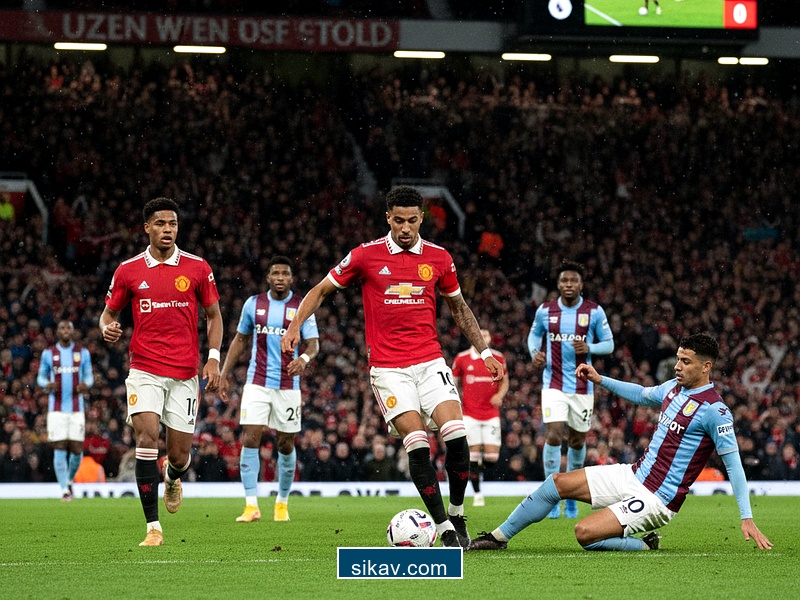
"Against Unai Emery, the pitch is compressed into thirty meters. If you play the pass too early, it’s offside. If you play it too late, the space is gone. The victory lies in the micro-second between the two."
The narrative surrounding Manchester United often descends into melodrama, but Sunday’s trip to Villa Park demands a cold, clinical detachment from the noise. We are not analyzing spirit or desire here. We are analyzing geometry. Unai Emery has constructed Aston Villa into one of Europe's most tactically distinct units, defined by an aggressively high defensive line and a condensed central box.
For United, the "ideal" lineup suggested by the data is not about fielding the eleven best names. It is about fielding the eleven specific profiles required to dismantle Emery’s offside trap and exploit the pockets of space that exist in the wide channels. The standard 4-2-3-1 often suffocates against Villa’s 4-4-2 mid-block. The solution lies in a hybrid 3-4-3 structure that prioritizes verticality over possession retention.
The Analysis: Breaking the Compressional Block
To understand how United must line up, we first accept the reality of the opponent. Villa defends in a narrow 4-4-2 shape. They surrender the wide areas to clog the center. If United attempts to play through the middle with slow, horizontal circulation, they will be turned over by Youri Tielemans and Amadou Onana, leading to lethal transitions via Ollie Watkins.
The tactical imperative is to bypass the midfield congestion entirely. This requires a back three in the build-up phase to create a 3v2 overload against Villa’s two strikers. This dictates the selection of Matthijs de Ligt centrally, flanked by Lisandro Martinez (for progressive passing angles) and Leny Yoro or a tucked-in right-back.
The Pivot: Resistance to Pressing
Villa triggers their press when the ball enters the central pivot. Therefore, United cannot afford a static double pivot. The selection of Manuel Ugarte is non-negotiable for this fixture. His role is not creative; it is destructive and protective. He must screen the back three against Morgan Rogers’ driving runs.
Partnering him requires Kobbie Mainoo’s press resistance. Mainoo operates best in tight spaces, capable of receiving the ball with his back to goal and spinning away from pressure. This specific skill—the "half-turn"—is the key to unlocking Villa. Once Mainoo breaks the first line of pressure, the pitch opens up. A player like Christian Eriksen, despite his passing range, lacks the mobility to survive the physical duel against Villa’s midfield engine room.
| Role | Player Selection | Tactical Function vs Villa |
|---|---|---|
| Ball-Playing CB | Lisandro Martinez | Direct vertical balls to bypass midfield block. |
| Press-Breaker | Kobbie Mainoo | Carrying through central congestion; drawing fouls. |
| Wide Threat | Alejandro Garnacho | Holding max width to stretch Villa's narrow back four. |
| The Runner | Rasmus Hojlund | Constant runs in behind Pau Torres. |
Weaponizing the Offside Trap
This is where the game will be won or lost. Emery’s high line is a high-risk, high-reward strategy. It relies on the assistant referee’s flag. To beat it, United cannot rely on a traditional number 10 playing through balls. The passer must be deeper—likely Andre Onana or Martinez—and the runner must start from a wider angle.
Rasmus Hojlund is the essential component here. His physicality disrupts the synchronized step-up of Villa’s center-backs. If Hojlund occupies the two center-backs physically, pinning them back even two yards, he fractures the straight line Emery demands. This creates the "grey zone" where Marcus Rashford or Alejandro Garnacho can exploit diagonal runs from out to in.
Bruno Fernandes, in this setup, should not play as a traditional 10. He must operate as a "False 8" in the right half-space. By positioning himself slightly deeper, he drags Pau Torres out of position. Torres likes to step up to engage; Fernandes must bait him into this movement. Once Torres steps, the channel opens for the wing-back or the wide forward to surge into the box.
The Wing-Back Isolation
Heat maps from Villa’s recent fixtures show a heavy concentration of activity in the central third. Their full-backs, Lucas Digne and Matty Cash (or Konsa operating wide), tuck in aggressively. This leaves the flanks exposed to rapid switches of play.
Noussair Mazraoui and Diogo Dalot become the primary outlets. When United possesses the ball on the left, Villa will shift the entire defensive block to that side. A rapid switch to Dalot on the right creates a 1v1 situation against a recovering defender. United must isolate Villa’s full-backs. The objective is not to cross early, but to drive to the byline. Cut-backs are statistically the most effective way to score against Emery’s sides because his defenders collapse toward the goal line, leaving the edge of the box (the cut-back zone) vacant.
Rest Defense and Transition
The danger of committing wing-backs high is the space left behind. Villa’s primary counter-attacking route is via Ollie Watkins pulling into the channels. United’s "rest defense" (the structure adopted while in possession to prepare for losing the ball) must be a 3-2 shape.
The three center-backs must remain compact. Martinez’s role is crucial here; he must be aggressive in engaging Watkins before he can turn. If United leaves themselves 2v2 at the back, Villa will score. The tactical discipline to keep three defenders back, even when chasing a goal, determines the result. It is not about caution; it is about negating Villa's single biggest strength.
- Formation: Hybrid 3-4-3 / 3-2-5 in possession.
- The Key: Hojlund pinning CBs deep to disrupt the offside line.
- The Outlet: Rapid switches to isolated wing-backs (Dalot/Mazraoui).
- Defensive Imperative: A rigid 3-2 rest defense to cage Ollie Watkins.
United possess the individual tools to exploit the specific weaknesses in Unai Emery’s system. The pace of the forwards against a high line is a theoretically perfect matchup. However, theory dies without structure. The lineup must reflect a commitment to verticality and width, eschewing the slow build-up that plays directly into Villa's hands. If United plays the ball quickly, stretches the pitch horizontally, and times the runs behind efficiently, the high line at Villa Park becomes a suicide note rather than a fortress wall.