
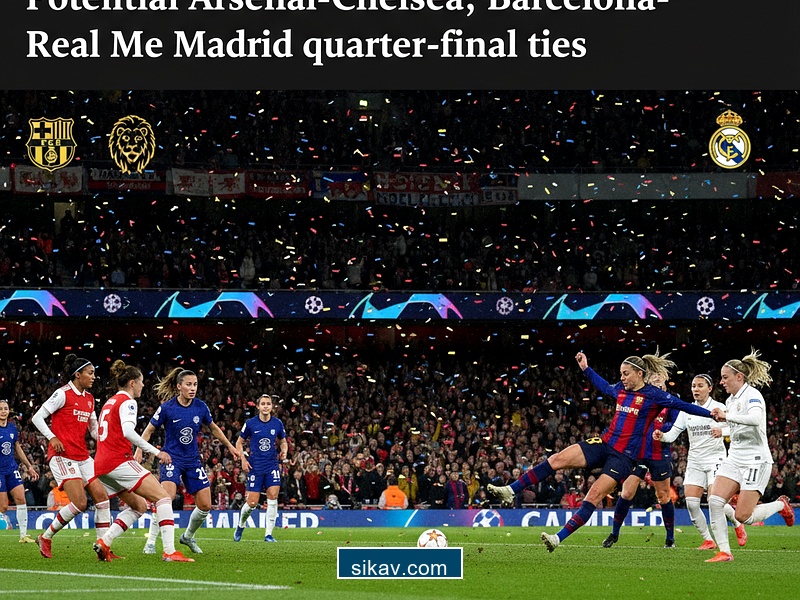
The narrative surrounding the Women’s Champions League quarter-final draw often devolves into storylines of rivalries and revenge. However, looking strictly at the data and structural configurations, the draw presents a fascination study in contrasting footballing philosophies. The prospect of an all-London clash between Arsenal and Chelsea, alongside a potential El Clásico in Europe, offers more than geographic proximity; it offers a collision of tactical systems that define the modern women's game.
We are witnessing a shift from individual brilliance to systemic dominance. The remaining teams do not just rely on star forwards; they rely on pressing triggers, inverted full-back rotations, and the manipulation of half-spaces. Analyzing the draw requires ignoring the badges and focusing on the chalkboards.
Barça vs. Madrid: The Geometry of Possession
If the draw solidifies a Barcelona versus Real Madrid quarter-final, the tactical mismatch is evident in the heatmap data from their respective domestic campaigns. Barcelona operates with a distinct 4-3-3 that morphs into a 2-3-5 in possession. The critical tactical element here is not the possession percentage—which often hovers near 70%—but the specific zones of occupation.
Barcelona’s dominance stems from their interior midfielders, specifically Aitana Bonmatí and Alexia Putellas (or Patri Guijarro), occupying the channels between the opponent's center-back and full-back. Real Madrid typically sets up in a 4-2-3-1 mid-block, attempting to clog central passing lanes. The tactical failure in this matchup historically occurs because Madrid’s double pivot gets dragged too wide to cover Barcelona's wing overloads.
"The structural flaw for Real Madrid is the isolation of their full-backs. When Graham Hansen holds width, she pins the defender, allowing the interior midfielder to make an unimpeded underlapping run. It is a simple geometric problem that Madrid’s current defensive schematic fails to solve."
For Real Madrid to advance in such a tie, the tactical burden falls on the transition via Caroline Weir. Barcelona’s aggressive high line leaves significant space behind the full-backs. Madrid’s only route to victory lies in bypassing the midfield entirely—utilizing vertical balls into the channels immediately upon turnover. However, Barcelona’s counter-pressing (winning the ball back within 5 seconds of loss) often suffocates these transitions before they begin.
Arsenal vs. Chelsea: The War of Intensity
A potential London derby in the Champions League operates on a different tactical frequency compared to the Spanish technicality. This tie represents a clash of "Control" (Arsenal) versus "Chaos" (Chelsea). Under Sonia Bompastor’s tactical evolution, Chelsea has embraced a high-octane, vertical style that prioritizes speed of attack over sustained possession.
Arsenal’s vulnerability lies in their rest defense. When Arsenal attacks, they commit numbers forward, often inverting full-backs like Emily Fox into central areas to create box midfields. This provides control but leaves the wide channels exposed. Chelsea’s primary tactical weapon—transitioning through wide forwards like Lauren James or Johanna Rytting Kaneryd—directly targets this structural weakness.
| Metric (Season Avg) | Arsenal | Chelsea | Tactical Implication |
|---|---|---|---|
| PPDA (Press Intensity) | 9.4 | 7.8 | Chelsea presses higher and more aggressively. |
| Direct Speed (m/s) | 1.42 | 1.85 | Chelsea attacks vertically faster; Arsenal builds slowly. |
| xG Conceded / 90 | 0.85 | 0.62 | Chelsea’s physical backline absorbs pressure better. |
The decisive battlefield in this potential matchup is Zone 14 (the area just outside the opponent's penalty box). Arsenal relies on intricately working the ball into this zone to release Alessia Russo or Stina Blackstenius. Chelsea’s double pivot is physically robust, specifically designed to collapse on this zone. If Arsenal cannot bypass Chelsea’s physical midfield screen, they are forced to cross from deep—a low-percentage strategy against Chelsea’s aerially dominant center-backs.
The Data of "Rest Defense"
Modern European analysis has shifted from focusing on what teams do *with* the ball to what they do *while attacking* to prevent counters—known as "rest defense." This is where the potential quarter-finalists diverge significantly.
The top contenders (Barcelona, Chelsea, Lyon) typically employ a 3-2 or 2-3 rest defense structure. This ensures that even when deep in the attacking third, five players are positioned behind the ball to sweep up clearances and prevent fast breaks. Contrast this with the teams likely to struggle in the quarters; their full-backs often overlap simultaneously, leaving a 2-2 or even 2-1 structure at the back.
In a potential Arsenal vs. Chelsea tie, the discipline of the full-backs becomes paramount. If Arsenal’s McCabe and Fox both push high, Chelsea’s ability to launch transitions into the vacated space behind them is statistically probable to result in high-xG chances. The data suggests that success in the upcoming rounds will correlate directly with defensive discipline during offensive phases, rather than offensive creativity alone.
Winning the Half-Spaces
The tactical evolution of the UWCL has killed the traditional winger. The "winger" in 2025 is either a wide forward cutting inside or a playmaker drifting wide. This distinction is crucial for the quarter-finals.
Barcelona exemplifies this best. Their width comes from the touchline, stretching the opponent's defensive line horizontally. This stretching creates gaps in the "half-spaces" (the vertical channels between the center and the wing). When Real Madrid compacts centrally to protect their goal, Barcelona utilizes the width. When Madrid spreads out to cover the width, Barcelona strikes through the half-spaces.
The tactical imperative for the underdog teams in these potential ties is compact verticality. They must shrink the pitch, reducing the effective playing area to a 30x40 meter box, forc