
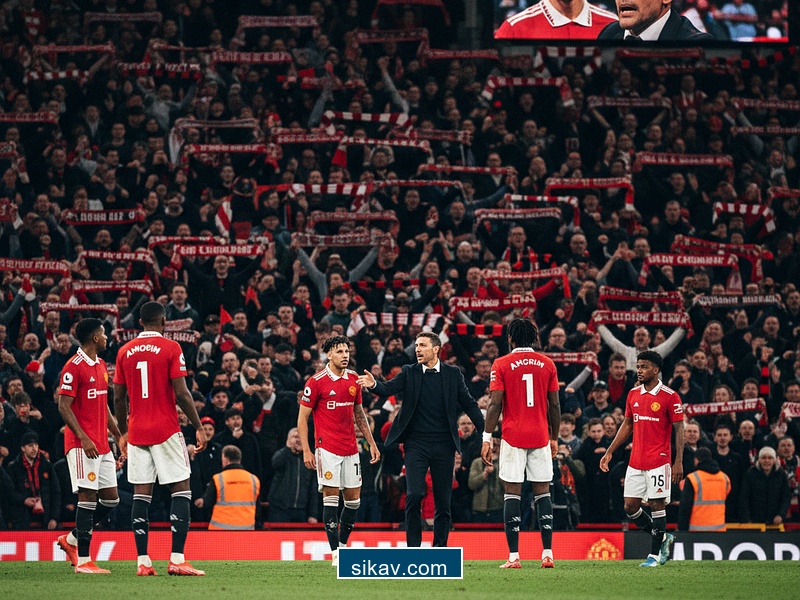
"You cannot rely on the badge to defend the half-spaces. The system requires suffering, compression, and a total rejection of comfort. Entitlement creates gaps, and gaps lose football matches."
Ruben Amorim’s recent critique regarding a "feeling of entitlement" within the Manchester United squad is often interpreted through a psychological lens. However, viewing this solely as a man-management issue ignores the fundamental tactical reality of his trademark 3-4-3 (or 3-4-2-1) formation. In Amorim’s tactical framework, psychological application is structural integrity. When a player switches off, they are not merely showing a poor attitude; they are physically breaking the geometric chains required to sustain the high-line press and the mid-block compression.
The "entitlement" Amorim references manifests on the pitch as a refusal to perform the dark arts of off-the-ball running and transition defense. This analysis strips away the narrative to examine exactly how a lack of work rate dismantles the complex mechanics of the 3-4-3 system, focusing on line-breaking failures, pressing triggers, and the isolation of the double pivot.
The Collapse of the Compact Block
Amorim’s system is predicated on vertical compactness. Ideally, the distance between the center-backs and the center-forwards should rarely exceed 25 to 30 meters when defending in a mid-block. This squeezes the opponent, denying them time on the ball between the lines.
The "entitlement" issue directly correlates to the behavior of the front three—specifically the two "inside 10s" operating behind the striker. If these players believe their role is exclusively creative, they fail to drop into the defensive shape immediately upon losing possession.
When the front line engages in a "passive press"—waiting for the ball to arrive rather than hunting it—the midfield pivot (the two central midfielders) is forced to cover an impossible amount of lateral ground. Opponents easily bypass the first line of pressure, finding pockets of space in front of United’s back three. The data shows United’s defensive line is retreating instinctively while the forward line remains static, stretching the team vertically and creating a massive zone in midfield for opponents to exploit.
Wing-Back Isolation and the Overload
The most physically demanding role in Amorim’s setup is the wing-back. In possession, they are wingers; out of possession, they must tuck in to form a back five. The systemic failure occurs when the attacking "entitlement" leaves these wing-backs isolated.
In a functioning 3-4-3, the wide center-backs (LCB and RCB) are aggressive, stepping up to nip attacks in the bud. However, they can only do this if the wing-back is supported by the near-side defensive midfielder or the dropping #10.
| Tactical Component | Ideal Amorim Execution | Current 'Entitled' Execution |
|---|---|---|
| Rest Defense | 3-2 shape, immediate counter-press. | Loose 3-1 shape, slow reaction to turnovers. |
| Pressing Trigger | Ball played to opponent fullback. | Delayed reaction; opponent circulates easily. |
| Half-Space Defense | #10 tracks back to double-team. | WB left 1v2 against winger/overlapping FB. |
Tactical video analysis reveals repeated instances where the wing-backs are subjected to 2v1 overloads. This happens because the forward players do not track the opposing fullback's overlap. Consequently, the United wing-back hesitates—caught between pressing the ball carrier or tracking the runner. This hesitation, born from a lack of support up the chain, shatters the defensive structure.
The Static Possession Problem
Entitlement is not just a defensive metric; it poisons offensive fluidity. Amorim’s 3-4-2-1 relies heavily on "automations"—pre-rehearsed movement patterns designed to manipulate opposing blocks.
When United possesses the ball, the heat maps often resemble a "U-shape"—circulating harmlessly from wing-back to center-back to wing-back. This sterility arises because the central midfielders and the dual #10s are not making the high-intensity, sacrificial runs required to open passing lanes.
To break a low block, a player must often make a run they know will not result in receiving the ball, purely to drag a defender away and create space for a teammate. This is the "suffering" Amorim alludes to. If players feel entitled to only move when they are the primary target of the pass, the rotation stalls. The team becomes predictable, static, and easy to defend against.
The Pivot Disconnect
We must scrutinize the role of the double pivot in this "entitled" environment. In the 3-4-3, the two central midfielders are the engine. They are often outnumbered by opponent midfields playing a 4-3-3. To survive this numerical disadvantage, the positioning must be flawless.
The current tactical breakdown sees the United pivots dropping too deep to collect the ball from the center-backs, trying to dictate play like quarterbacks. However, Amorim requires them to be vertical shuttlers, receiving the ball under pressure in tight areas to trigger quick transitions.
When the pivots drop too deep (a safe, "comfortable" choice), they disconnect from the forward line. This forces the team into long, hopeful balls rather than intricate passing combinations. The reluctance to play in the chaotic, high-pressure zones of the central pitch is a tactical manifestation of the psychological entitlement Amorim highlighted. They want the ball in comfort, not in conflict.
Defending the Transition
The most damning evidence lies in the transition stats. Amorim’s teams usually excel at the "five-second rule"—winning the ball back immediately after losing it. United currently exhibit a distinct lag time.
This is not just laziness; it is a structural