
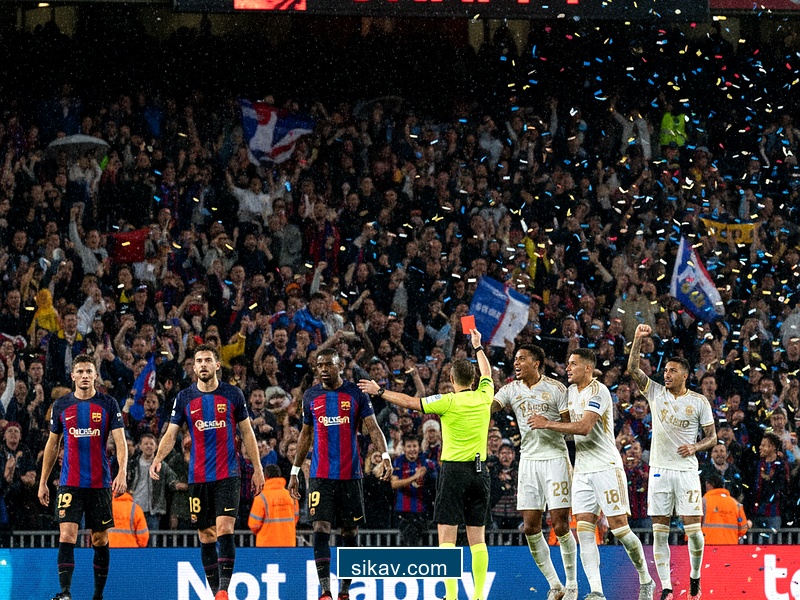
Hansi Flick’s systemic revolution at Barcelona relies entirely on central overload, a mechanic now shattered by the sudden absence of his primary connector between the lines. Facing Villarreal’s ruthless transition game without this tactical linchpin forces a regression from proactive domination to reactive instability. The injury is not merely a personnel loss; it represents a fundamental breakdown of the vertical passing lanes that define this new era.
| Tactical Metric | With Primary #10 (Olmo/Fermin) | Projected Adjustment | Villarreal Threat Level |
|---|---|---|---|
| Central Progressive Receives | 8.4 per 90 | 4.1 per 90 (Wide drift) | CRITICAL |
| Pressing Intensity (PPDA) | 7.2 | 9.5 (Less cohesive) | HIGH |
| Half-Space Occupation | High (Zone 14 focus) | Low (Wing overload) | MODERATE |
Why The Numbers Matter
The data above illustrates a frightening reality for Hansi Flick: the loss of his central progression engine cuts Barcelona’s vertical threat in half. The German manager’s "unhappiness" is rooted in geometry, not emotion. Without a specialist capable of receiving the ball on the half-turn in Zone 14 (the area just outside the opposition penalty box), Barcelona’s possession becomes sterile "U-shaped" circulation. Against Villarreal, a team that thrives on luring opponents into wide traps before countering through the center, this statistical drop-off in central receiving implies the Catalans will struggle to bypass the first line of pressure, playing directly into Marcelino’s 4-4-2 mid-block hands.
The Half-Space Vacuum
Flick’s 4-2-3-1 system differs significantly from Xavi’s previous positional play. It requires a "Raumdeuter" (space investigator) in the number 10 role—a player who operates primarily between the opponent's center-backs and defensive midfielders. The injury to this vital profile creates a structural vacuum. When Barcelona builds from the back, they rely on vertical passes breaking two lines of defense instantly.
With this player removed, the replacement (likely Raphinha drifting centrally or Pablo Torre) changes the physics of the attack. Raphinha seeks to attack depth behind the line, while Torre drops too deep to collect. Neither offers the specific "pinning" mechanic required to freeze Villarreal’s center-backs. Consequently, Villarreal’s defenders can step up and compress the space, suffocating Pedri and Marc Casadó in the pivot roles. The absence of a player occupying the "pocket" allows the opposition defensive line to squeeze forward, reducing the pitch size and increasing the efficacy of their press.
Villarreal’s Trap: The 4-4-2 Block vs. Depleted Progression
Marcelino’s Villarreal sets up in a compact, rigid 4-4-2 out of possession. Their primary defensive objective is to deny entry passes into the central block. When facing a fully fit Barcelona, the threat of the number 10 receiving behind their midfield line forces Villarreal’s double pivot (Parejo and Comesaña) to sag back. This retreat opens space for Barcelona’s own pivots to dictate play.
However, with the injury removing that central threat, Parejo and Comesaña can step 10 yards higher. They can engage Barcelona’s build-up man-to-man without fear of being bypassed by a single pass. This creates a high-turnover environment. If Barcelona attempts to force the ball through the center without their specialist receiver, Alex Baena and Yeremy Pino are positioned perfectly in the half-spaces to intercept and launch immediate counters. The injury transforms Villarreal’s defensive stance from "containment" to "aggression."
Compromised Pressing Triggers
Flick’s annoyance stems equally from the defensive implications. His system employs a high press where the number 10 acts as the trigger man, shadowing the opponent’s deepest midfielder (the #6) while simultaneously pressing the center-backs. This hybrid pressing role requires immense stamina and tactical intelligence to cut passing lanes while sprinting.
"The structure of the press relies on the #10 cutting the pitch in half. Without that specific movement, the opponent finds the spare man easily."
Without the first-choice energy in this role, the pressing chain breaks. If the replacement is a fraction of a second late to jump on Villarreal’s Raul Albiol or Logan Costa, the ball circulates to Dani Parejo in space. Once Parejo has time to turn and look up, Barcelona’s high line—held by Iñigo Martinez and Pau Cubarsí—becomes a liability rather than a strength. The injury forces the defensive line to drop deeper to compensate for a less effective first line of pressure, stretching the team vertically and leaving gaps that Villarreal’s Ayoze Pérez exploits ruthlessly.
The Necessary Adjustment: Inverted Full-Backs
To mitigate this loss, expect Flick to demand more from Jules Koundé. Rather than overlapping down the right flank, Koundé must invert fully into the defensive midfield line to create a 2-3-5 structure in possession. By adding an extra body centrally, Barcelona can artificially recreate the numerical superiority they lost with the injury.
This adjustment carries risk. Inverting Koundé leaves the right defensive channel exposed to Alex Baena, one of La Liga’s most dangerous transition creators. Yet, Flick has no choice. He must prioritize central control to sustain possession, even if it means gambling on the pace of his center-backs to cover the wide areas during transitions. The tactical battle at La Cerámica will be defined not by who has the ball, but by how Barcelona manages the geometry of their midfield absence against a team built to exploit exactly that kind of void.