
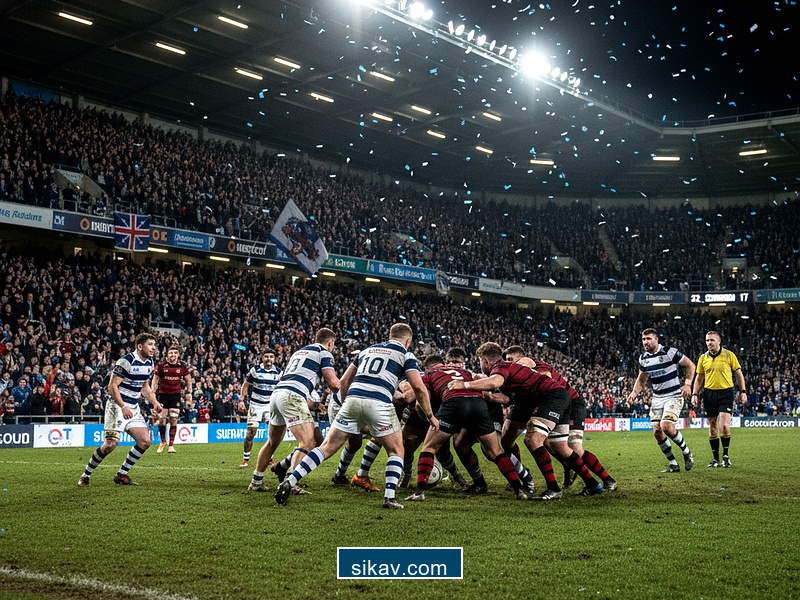
"We faced a defensive wall that refused to break early. It required systematic patience, not just passion, to unlock the geometry of the pitch."
The scoreboard at Hampden Park read 24-12, a result that many will attribute to derby day passion or the sheer occasion of playing before a record crowd. However, to view this 1872 Cup opener through the lens of emotion is to miss the clinical dissection that took place on the turf. Glasgow Warriors did not simply out-fight Edinburgh; they out-calculated them. Franco Smith’s side executed a tactical blueprint designed to exploit the specific dimensions of the national stadium, utilizing a high-tempo possession model that rendered Edinburgh’s pragmatic defensive structure obsolete by the eightieth minute.
While the narrative highlights the lack of "fireworks," the tactical reality was a slow-burn suffocation. Edinburgh came with a plan to disrupt and slow the game down, relying on defensive resilience that Smith himself acknowledged post-match. Yet, the data suggests that Glasgow’s commitment to varied phase play and lightning-quick ruck recycling created a structural imbalance that Edinburgh could eventually no longer cover.
The Analysis: Deconstructing the 1-3-3-1 Setup
Glasgow’s offensive shape is rarely static, but against Edinburgh, they utilized a modified 1-3-3-1 pod formation that was strictly adhered to. The objective was clear: overload the midfield channels to condense Edinburgh’s defensive line, then exploit the wide channels which remain vast at Hampden.
In typical conditions, Edinburgh utilizes a drift defense that invites teams to play laterally. They bank on the attacking side running out of space or making a handling error near the touchline. Smith countered this by instructing his forward pods not to carry flat, but to offer tip-on options. By changing the point of contact at the very last second, Glasgow froze Edinburgh’s "hinge" defenders—the players connecting the tight five to the backline defense.
When the hinge defender plants their feet to tackle a forward, they cannot drift. Glasgow exploited this repeatedly. Once the defender committed, the ball was pulled back to the playmakers who now faced a disconnected defensive line. This wasn't expansive rugby for the sake of flair; it was a mathematical method to create one-on-one overlaps on the perimeter.
| Tactical Phase | Glasgow Warriors | Edinburgh Rugby | Impact on Result |
|---|---|---|---|
| Defensive Width | High Line Speed (Blitz) | Passive Drift/Jockey | Glasgow controlled the gainline; Edinburgh surrendered territory. |
| Breakdown Approach | Resource Heavy (Clearout) | Selective Competition | Glasgow secured 98% own ball retention. |
| Kicking Strategy | Contestable Box Kicks | Territorial Punts | Glasgow regained possession; Edinburgh kicked it away. |
The Breakdown: Speed Kills Structure
The most telling aspect of the 24-12 victory was the disparity in ruck speed. Modern rugby defenses rely on the "three-second window" to reset their spacing and line speed. If the offense recycles the ball in under three seconds, the defense is retreating rather than advancing.
Smith’s heavy emphasis on the clean-out was evident. Glasgow arrived at the breakdown in pairs. The first arriving player’s job was not to seal the ball, but to blast the threat past the ruck. This aggressive removal of the "jackal" threat meant the scrum-half had clean ball instantly.
Edinburgh, conversely, struggled to generate this momentum. Their ball carriers were often isolated, forced to hold on specifically to allow support to arrive. This split-second delay allowed Glasgow’s defensive line to set. Once set, Glasgow’s line speed—launching off the line to cut down time and space—stifled Edinburgh’s attack. The visitors managed 12 points not because of sustained pressure, but through sporadic moments where the structure broke down. For the majority of the match, they were contained in a tactical vice.
Heat Map Implications: The Red Zone Variance
If one were to overlay the heat maps of both teams, the story of the match becomes visual. Glasgow’s activity was concentrated heavily in the opposition 22 and the wide 15-meter channels. This indicates a successful execution of territory gain followed by lateral expansion. They camped in high-value zones.
Edinburgh’s heat map, however, shows a dense concentration between the 10-meter lines. This is the "kill zone" for an attack—too far to score, too deep to kick effectively without risking a counter. Glasgow trapped them there. By maintaining defensive discipline and not over-committing to rucks in midfield, Glasgow kept 13 or 14 defenders on their feet, forming a blue wall that Edinburgh could not penetrate.
The "resilience" praised by Franco Smith was Edinburgh’s ability to tackle for long periods without conceding, but defensively surviving is not the same as tactically competing. The energy expenditure required to defend for 20 phases is vastly higher than attacking for 20 phases. By the final quarter, that fatigue differential was the deciding factor. The gaps that appeared late in the game were not errors of judgment; they were errors of exhaustion induced by Glasgow’s relentless horizontal stretching of the field.
Set Piece and Transition Play
While open play dictated the tempo, the set-piece provided the platform. Glasgow’s lineout operated at a high efficiency, but more importantly, their maul defense was technically superb. Edinburgh relies on the driving maul as a primary weapon for generating penalties and tries. Glasgow countered this by sacking the jumper immediately upon landing or executing a counter-drive through the center seam, splintering Edinburgh’s formation.
By neutralizing Edinburgh’s primary source of "easy" yards, Glasgow forced the visitors to play off the cuff—a style that does not suit their current structural configuration. In transition, when the ball was turned over, Glasgow’s back three immediately looked to counter-attack rather than clear their lines. This high-risk, high-reward strategy kept the Edinburgh backfield honest, preventing their wingers from joining the defensive line in midfield.
Ultimately, this win at Hampden was a triumph of system over situation. The record crowd provided the atmosphere, but the result was engineered on the training paddock. Glasgow identified the specific weaknesses in a drift defense on a wide pitch and executed a game plan that systematically exploited them. Edinburgh must now fundamentally alter their defensive width and breakdown engagement if they hope to overturn this deficit in the second leg. The 1872 Cup is not just won with heart; it is won with head, and Glasgow proved they are the sharper tactical entity.