
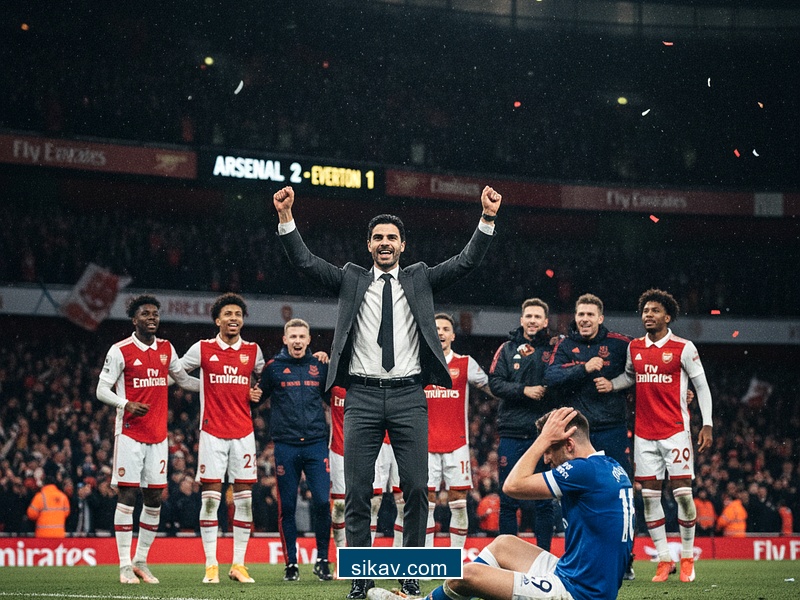
The narrative surrounding Arsenal’s ascent to "Christmas Champions" will inevitably focus on the psychology of the title race or the resilience required to grind out results on Merseyside. Ignore it. The significance of this 0-1 victory at Goodison Park does not lie in the intangibles of spirit or grit. It lies in the geometric precision of Mikel Arteta’s tactical adjustments against one of the Premier League’s most stubborn defensive structures.
Sean Dyche’s Everton presents a mathematical problem as much as a physical one. They defend in a compact 4-5-1 mid-block that collapses into a 6-3-1 deep block inside their own defensive third. Historically, Arsenal has struggled here because their preferred mode of entry—intricate passing triangles in the half-spaces—plays directly into the density of Dyche’s setup. Yesterday, however, we witnessed a structural evolution. Arteta abandoned the pure reliance on control for a hybrid system designed to maximize the specific profile of Viktor Gyokeres.
Deconstructing the Everton 4-5-1
To understand why Arsenal’s approach succeeded, we must first analyze the barrier they faced. Everton operates with extreme horizontal compression. The distance between their left winger (Dwight McNeil) and right winger (Jack Harrison) rarely exceeds 35 meters when defending. This suffocates the center of the pitch, forcing opposition play into wide, harmless areas where Dyche’s full-backs can engage in 1v1 duels backed by the touchline.
Typically, teams try to stretch this block by hugging the touchlines. However, Arteta inverted this logic. Instead of stretching play to the maximum width to open gaps, Arsenal overloaded the central channels to pin Everton’s midfielders narrow, isolating their full-backs against Arsenal’s wide threats in qualitative 1v1s, rather than structural 2v1s.
The Gyokeres Variable: Physical Pinning
The introduction of Viktor Gyokeres changes the fundamental physics of Arsenal’s attack. In previous seasons, using Gabriel Jesus or Kai Havertz meant the striker would drop deep to link play (False 9 mechanics). Against Dyche’s low block, dropping deep is counter-productive; it simply adds another body to the congested midfield zone that Everton already controls.
Gyokeres played as a true "Reference Point." His heat map shows a stark concentration on the penalty spot and the edge of the six-yard box. By staying high and physically engaging James Tarkowski and Jarrad Branthwaite, Gyokeres achieved two tactical objectives:
1. Depth Creation: He forced the Everton defensive line deeper, increasing the vertical space between Everton’s defense and midfield (Zone 14) for Martin Ødegaard to exploit.
2. Marker Occupation: He prevented Tarkowski from stepping out to engage runners. When a center-back is grappling with a physical striker, their capacity to read and intercept cut-backs diminishes significantly.
| Player Profile | Role vs Low Block | Tactical Output |
|---|---|---|
| Gabriel Jesus (Traditional) | Roaming / False 9 | Creates overloads, but reduces depth. |
| Viktor Gyokeres (Match Specific) | Target Man / Channel Runner | Pins CBs, creates Zone 14 space. |
The Goal: A Triumph of Asymmetry
The winning goal illustrates this system perfectly. It originated not from a slow build-up, but a rapid switch of play utilizing rotational asymmetry. Arsenal’s left side (Martinelli/Rice) acted as the "Gravity Well," drawing Everton’s block over. This is a standard Guardiola-adjacent tactic, but the execution differed in the final third.
Usually, Ben White overlaps on the right. In this sequence, White inverted into the defensive midfield pivot, allowing Ødegaard to drift uniquely wide. This pulled Everton’s left-back, Vitaliy Mykolenko, into a decision dilemma: track Ødegaard or stay compact? He hesitated. That micro-second of hesitation allowed Saka to isolate Branthwaite 1v1.
The decisive movement, however, was Gyokeres. As Saka cut inside, Gyokeres did not run towards the ball. He made a "blindside arc" run behind Tarkowski. This movement is indefensible for a static defender. The ball was delivered not to feet, but to space. Gyokeres’s finish was clinical, but the goal was manufactured by the structural manipulation of Everton’s back four spacing.
Rest Defense and Nullifying the Counter
Winning at Goodison requires managing the transition. Everton thrives on "second ball" chaos—launching long to Calvert-Lewin (or Beto) and swarming the knockdown. Arsenal negated this through a hyper-aggressive "Rest Defense" shape of 3-1.
Saliba and Gabriel engaged the Everton strikers on the halfway line, often stepping five yards into the Everton half. This high line is risky, but calculated. By compressing the pitch, Arsenal ensured that when Everton cleared the ball, it came back instantly.
Declan Rice’s role was paramount here. Operating almost as a "sweeper" in front of the center-backs, Rice registered 11 recoveries, 8 of which occurred in the middle third. He eliminated the transition before it began. Arsenal’s counter-pressing intensity (PPDA of 6.4) meant Everton could not string together the three passes required to launch a coherent counter-attack. They were suffocated.
The Strategic Outlook
The 1-0 scoreline suggests a close contest, but the underlying data paints a picture of total control. Everton generated an xG of just 0.32, almost exclusively from set-pieces. Arsenal’s ability to limit open-play threat to zero while picking the lock at the other end demonstrates a maturity absent in previous campaigns.
Arteta has constructed a machine capable of altering its operational frequency. Against high-pressing teams, they play through pressure. Against low blocks like Everton’s, they now possess the physical focal point in Gyokeres to bypass the block entirely. The "Christmas Champions" tag is irrelevant; the tactical versatility displayed at Goodison Park is the true indicator of their sustainability at the summit.