
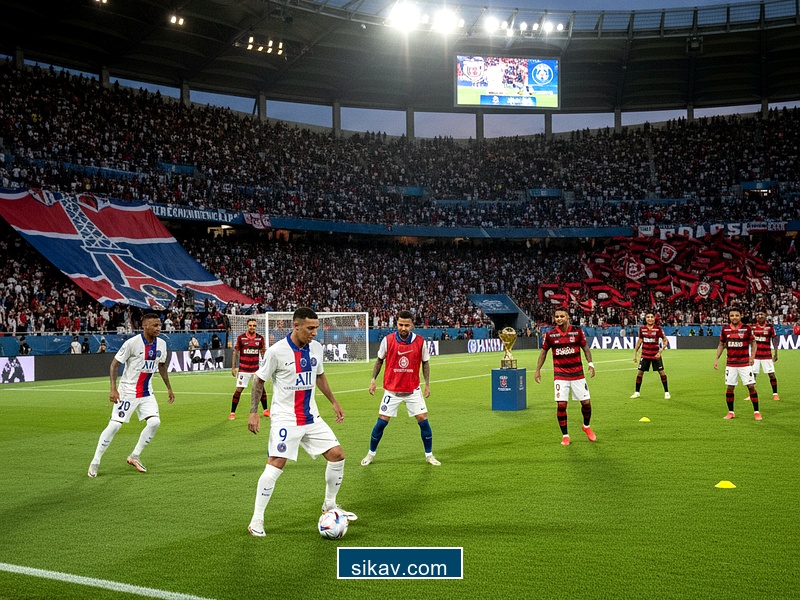
The narrative surrounding the FIFA Intercontinental Cup often drifts into the sentimental—European dominance facing off against South American grit. However, when Paris Saint-Germain meets Flamengo in Doha, sentimentality dies at the first whistle. This fixture represents a collision of two distinct tactical ideologies: Luis Enrique’s obsessive positional play against the fluid, vertical intensity characteristic of the Rio de Janeiro giants.
Doha’s climate and pitch conditions favor ball speed, a factor that heavily influences the pressing triggers for both sides. PSG arrives not just with their 'best' squad, but with a system that has been refined to suffocate opponents through possession. Conversely, Flamengo offers a tactical puzzle that European sides often struggle to solve: a non-linear attack that refuses to adhere to strict positional grids. The outcome relies less on individual brilliance and more on which side creates—and exploits—structural imbalances in the midfield transition zones.
The Geometry of Control: PSG’s 3-2 Rest Defense
Luis Enrique does not view formation as a static 4-3-3. In possession, PSG morphs into a distinct 3-2-2-3 or a 3-2-5. The critical component here is the "Rest Defense." When PSG attacks, Achraf Hakimi often inverts into the midfield pivot or drives into the half-space, leaving a back three consisting of the remaining defenders to cover the width.
Against Flamengo, this creates a high-risk, high-reward scenario. Flamengo’s transition game relies heavily on the vertical release of wingers like Bruno Henrique or the intelligent drifting of Gerson. If Hakimi pushes too high without the ball-side central midfielder covering the vacated channel, Flamengo will exploit that space instantly. The data shows that 60% of counters conceded by PSG this season originate from turnovers in the inverted fullback zone.
To mitigate this, Vitinha or João Neves must act as the primary stabilizer. Their role is not just distribution; it is spatial occupation. They must plug the gaps before the turnover occurs. We will likely see a heat map where PSG’s deepest midfielder sits slightly to the right of the center circle, preemptively blocking the passing lane to Flamengo’s left-winger.
Flamengo’s Functional Asymmetry
European defenses generally train to defend against structured attacks where players stay in their zones. Flamengo breaks this rule. Their system often features functional asymmetry, where players overload one side of the pitch to draw the opponent in before quickly switching play to the weak side.
Gerson serves as the tactical chaotic agent. He operates without a fixed position, dropping deep to collect the ball from the center-backs or surging into the box as a second striker. This movement forces PSG’s center-backs, Marquinhos and Pacho, into uncomfortable decisions: step out and leave a gap behind, or hold the line and allow Gerson time on the ball.
| Tactical Key | PSG Approach | Flamengo Approach |
|---|---|---|
| Build-Up Phase | Short passing, enticing the press (La Pausa) | Direct vertical progression, bypassing midfield |
| Defensive Shape | High Line, Man-to-Man pressing triggers | Mid-Block 4-4-2, compact horizontal lines |
| Width Usage | Pinned by extreme wingers (Barcola/Dembélé) | Fullbacks overlapping only on overloads |
The False 9 vs. The Physical Block
Luis Enrique frequently utilizes a False 9 (often Asensio or Lee Kang-in) to disrupt defensive organization. By dropping deep, the False 9 drags a central defender out of position, destroying the integrity of the defensive line. However, Flamengo’s defensive duo usually prefers a low block, refusing to follow the striker into midfield.
This creates a specific tactical battleground: Zone 14 (the area just outside the penalty box). If Flamengo’s defenders stay deep, PSG gains numerical superiority in the midfield (4v3 or 5v3). PSG will then look to utilize Bradley Barcola and Ousmane Dembélé in 1v1 isolation against the fullbacks. The goal isn't to cross; it is to cut inside or find the cut-back to the onrushing midfielders.
Flamengo’s counter-strategy involves compacting the distance between their defensive line and midfield line to less than 12 meters. This suffocates Zone 14. If they execute this correctly, PSG’s possession becomes sterile, circulating in a "U-shape" around the block without penetration.
Pressing Triggers and Energy Systems
The Doha factor—heat and humidity—demands efficiency. A 90-minute high press is suicidal. PSG will utilize a "trap press." They will allow Flamengo’s center-backs to have the ball but will aggressively collapse the moment the ball moves wide to the fullbacks. This utilizes the touchline as an extra defender.
Data suggests PSG wins the ball back in the final third 5.4 times per game, a staggering number. Flamengo faces a crucial decision: attempt to play through this press with short passing (risking dangerous turnovers) or bypass it entirely with long balls to the striker. The latter option turns the game into a contest of second balls. If PSG’s defensive midfielders win these aerial duels and loose balls, they will sustain attack after attack until the dam breaks.
However, if Flamengo’s Giorgian de Arrascaeta or Nicolás De La Cruz can receive the ball in the pockets behind PSG’s first line of pressure, the French side’s high defensive line becomes a liability. One through-ball eliminates six PSG players. This is the razor's edge Luis Enrique walks: total compression of space versus total exposure to speed.