
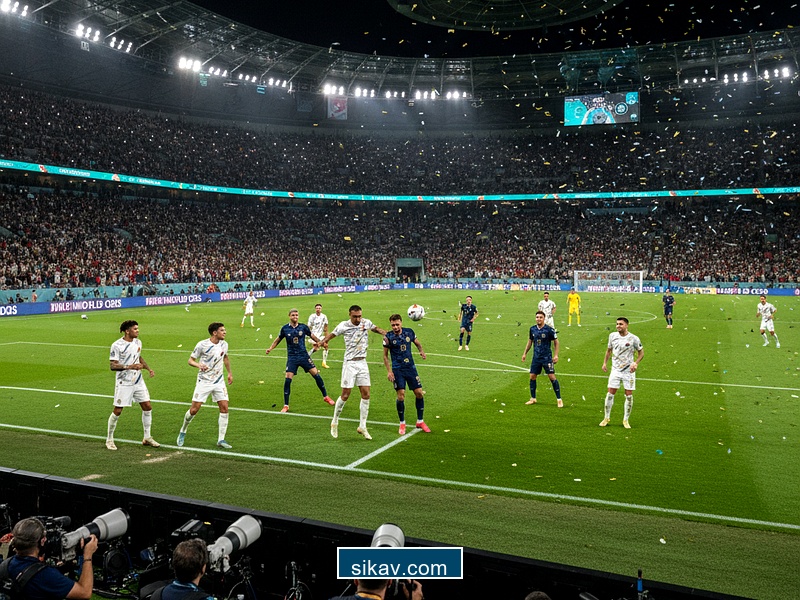
The script was finished. The credits were rolling. When Lionel Messi kissed the golden trophy in Lusail Stadium on that humid December night in 2022, the world collectively exhaled. The hero’s journey was complete. The ghosts of Maracanã in 2014 were exorcised; the weeping figure of the Copa América Centenario was replaced by a deity hoisted onto the shoulders of his countrymen. He had completed football.
But football, specifically the corporate behemoth that governs it, does not care for narrative closure. It cares for expansion, for revenue, and for the spectacle. The latest announcement from FIFA has cast a blinding, diamond-encrusted light on the upcoming 2026 tournament in North America. The governing body has confirmed a staggering 50% increase in the prize pot, with the eventual winners set to pocket a record-breaking $50 million (£39.5m).
Suddenly, the 2026 World Cup is not just an epilogue or a victory lap for the Argentine captain. It has transformed into a high-stakes heist. The announcement places Lionel Messi, now residing in the very country that will host the final, at a complex crossroads. Does the man who has everything return to claim the biggest bounty ever placed on a sporting event, or does he walk away and let the wolves fight over the meat?
The Analysis
This influx of cash changes the texture of the tournament. While players of Messi's caliber earn astronomical wages at the club level, the World Cup prize money has historically been symbolic—a bonus for the federation to reinvest. However, $50 million is a sum that alters federation politics. It creates pressure. For the Argentine Football Association (AFA), the presence of Messi in 2026 is no longer just a sentimental desire; it is a financial imperative. With him, their odds of securing that $50 million check skyrocket. Without him, they are a team in transition.
Messi finds himself in a uniquely modern tragic positioning. He is the gladiator who won his freedom, yet the emperor (FIFA) keeps throwing gold into the arena, daring him to pick up his sword one last time. He plays his club football in Miami now, effectively in the backyard of the 2026 final. Every day, the American media machine, fueled by this new announcement of record-breaking stakes, asks the same question: "Will he be there?"
The tragedy lies in the risk. If Messi succumbs to the temptation of this "Golden World Cup," he risks the one thing money cannot buy: the pristine nature of his exit. We saw Cristiano Ronaldo rage against the dying of the light in 2022, a fallen king leaving the pitch in tears, diminished by his own refusal to yield to time. Messi achieved the perfect goodbye. To return for a tournament defined by its grotesque financial scaling—a 48-team bloated spectacle—risks turning him into a product rather than a legend.
The Cost of Greed
The narrative of the $50 million prize brings a darker undertone to Messi's potential participation. The source reports highlight a crucial disconnect: while FIFA boasts of its solvency and generosity toward the federations, fan representatives are crying foul. A fans’ chief noted that this huge prize pot proves FIFA can afford to cut ticket prices, yet the trend suggests the opposite. The 2026 World Cup is shaping up to be an exercise in maximum extraction.
Messi has always represented the antithesis of the suit-and-tie bureaucracy of football. He is the street footballer, the "pibe" from Rosario who plays for the love of the ball. But in 2026, he would be the face of the most commercialized sporting event in human history. The $50 million prize is not a reward for footballing excellence; it is a dividend of the American market. If Messi plays, he legitimizes the greed. He becomes the hood ornament on a machine designed to squeeze every dollar out of the fans who worship him.
Consider the physical toll. By the time the 2026 final kicks off, Messi will be 39 years old. The romantic idea is that he plays a midfield general role, spraying passes like Pirlo. The reality of modern international football is pressing, speed, and violence. Can the aging king protect his legacy when the opposition is running on the jet fuel of a $50 million incentive? Every tackle will be harder. Every nation will want to be the one that took down Messi for the biggest purse in history.
| Era | Messi's Status | The Stakes |
|---|---|---|
| 2014 (Brazil) | The Unfulfilled Genius | Historical Validation |
| 2022 (Qatar) | The Burdened Leader | Immortality ($42m Prize) |
| 2026 (USA) | The Reluctant God? | Excess & Legacy ($50m Prize) |
The Final Decision
The sheer volume of cash FIFA is pumping into this tournament—a 50% increase in the total pot—signals that they are terrified of a post-Messi, post-Ronaldo world. They are trying to buy excitement. They need Messi to chase that $50 million to distract from the lack of new, transcendent stars with the same global gravity.
For the player himself, the money is irrelevant. He has generated wealth that will last for generations. What matters is the mirror. When he looks at himself in the quiet moments in Miami, does he see a man who needs one more fight? Or does he see a man who knows that returning to the mountain top only offers a chance to fall?
The world watches and waits. The check has been written. The amount is set. $50 million sits on a table in Zurich, waiting for a captain to claim it. It calls out to the competitive beast inside Lionel Messi, whispering that he could do it one more time. But perhaps true heroism now is not in taking the money and the risk, but in knowing that some things—like a perfect ending—are priceless.