
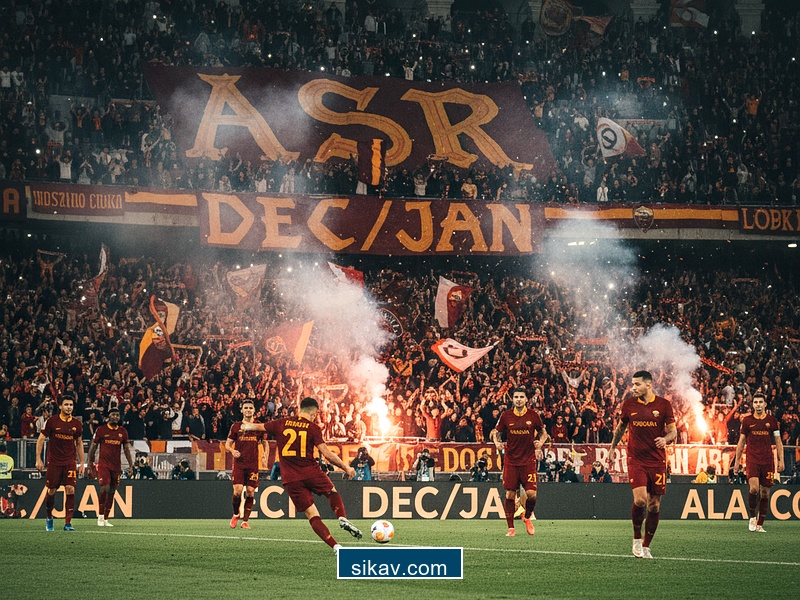
Can you hear it? That low, guttural rumble rising from the banks of the Tiber. It starts in the cafes of Testaccio, weaves through the crowded streets of Trastevere, and explodes into a deafening roar inside the concrete bowl of the Stadio Olimpico. This is not just noise. It is anxiety. It is passion. It is the sound of a city holding its breath.
We are standing on the precipice. December and January. Two months that look innocuous on a calendar but look like a death march on a fixture list. The air in the stadium has changed. The warm, lazy evenings of early autumn are gone, replaced by the biting dampness of a Roman winter. The flares burn brighter against the grey sky. The smoke hangs lower, choking the pitch, adding to the claustrophobia.
AS Roma enters the gauntlet. The Giallorossi are staring down a slate of games so congested, so physically demanding, that it threatens to snap the very tendons of the squad. This isn't football management; it's crisis management. Every fan in the Curva Sud knows the stakes. We feel it in our bones. One slip, one moment of weakness in these freezing weeks, and the season unravels. But if they stand tall? If the Wolves hunt as a pack? We touch the sky.
Over the next 60 days, the fixture density increases by nearly 40%. Roma faces a relentless cycle of Serie A battles and potential cup fixtures, averaging a high-intensity match every 4.5 days. There is no time to bleed.
The Analysis: Walking Through Fire
The schedule makers have shown no mercy. A glance at the upcoming weeks reveals the brutal reality of modern football. It is a carousel of violence and fatigue. We are talking about league fixtures that carry the weight of cup finals. We are talking about the Coppa Italia, a trophy this city craves with a desperate hunger. The rotation of the squad becomes the only tactical conversation that matters.
In Rome, nothing is ever simple. The "piazza"—the environment, the media, the radio stations that broadcast 24 hours a day—amplifies every pass, every error. A congested schedule in Manchester or Munich is a logistical challenge. In Rome, it is an emotional reckoning. When the games pile up, the nerves fray. The scrutiny intensifies. Players don't just battle the opposition; they battle the immense, crushing weight of expectation from a fanbase that has suffered too much and loves too hard.
The Physical Toll of the Marathon
Let's talk about the legs. Heavy, leaden legs. The pitches in Italy during December and January can be treacherous. The cold snaps muscles. The rain turns turf into mud. This is where the depth of the squad is exposed. You cannot play the same eleven gladiators three times a week without consequences.
We will see who hides and who steps up. This is the period where heroes are forged in the freezing rain. We need the fringe players to become titans. We need the Primavera graduates to play like veterans. The medical staff becomes as important as the coaching staff. Every ice bath, every massage, every minute of sleep counts. The margin for error is microscopic. A single hamstring tear can derail the momentum of the entire campaign.
And the opposition knows it. They smell blood. Teams coming to the Olimpico in this period will try to make the game physical. They will try to drag Roma into a brawl, knowing the legs are tired. The Giallorossi must be smarter. They must control the tempo, conserve energy, and strike with the ruthlessness of a predator.
The Curva Sud: The Heartbeat in the Cold
You cannot analyze this schedule without talking about the 12th man. The Curva Sud does not hibernate. If anything, the cold makes them louder. They wrap their scarves tighter and scream until their throats bleed. They know the team is tired. They know the schedule is unfair. And that is why they sing louder.
During this slate of games, the connection between the stands and the pitch must be electric. When the team's energy fades in the 80th minute of a Wednesday night slog, the roar of the Sud provides the adrenaline. It is a symbiotic relationship unique to this city. They feed us hope; we feed them noise. The players must look up into that wall of flags and flares and find something extra within themselves. They are not playing for a paycheck; they are playing for the people shivering in the stands.
| Challenge Factor | Impact Level | The Reality |
|---|---|---|
| Squad Depth | CRITICAL | Bench players must perform immediately. |
| Injury Risk | HIGH | Muscle fatigue peaks in Jan. |
| Fan Pressure | VOLATILE | Patience wears thin in winter. |
Destiny Awaits
We have seen Roma teams of the past crumble in the winter. We have seen the "Gennaio Nero" (Black January) where dreams go to die. But there is a different steel in the air this time. A sense that the suffering is the point. That through this brutal slate of games, the team will find its true identity.
Every tackle will echo. Every goal will be a release of pent-up fury. This is what we live for. Not the easy wins in August sunlight, but the ugly, grinding victories in the January frost. This is where the season is decided.
- The fixture list for December and January presents the ultimate physical test for the squad.
- Rotation is no longer a luxury; it is an absolute necessity for survival.
- The atmosphere at the Stadio Olimpico will be the deciding factor in pushing tired legs forward.
- History warns of winter slumps, but this team has the chance to rewrite the narrative.
So let the whistle blow. Let the games begin. The Wolves are hungry, and the winter is long. We stand ready in the stands, hearts pounding, ready to suffer, ready to triumph. Forza Roma, always.