
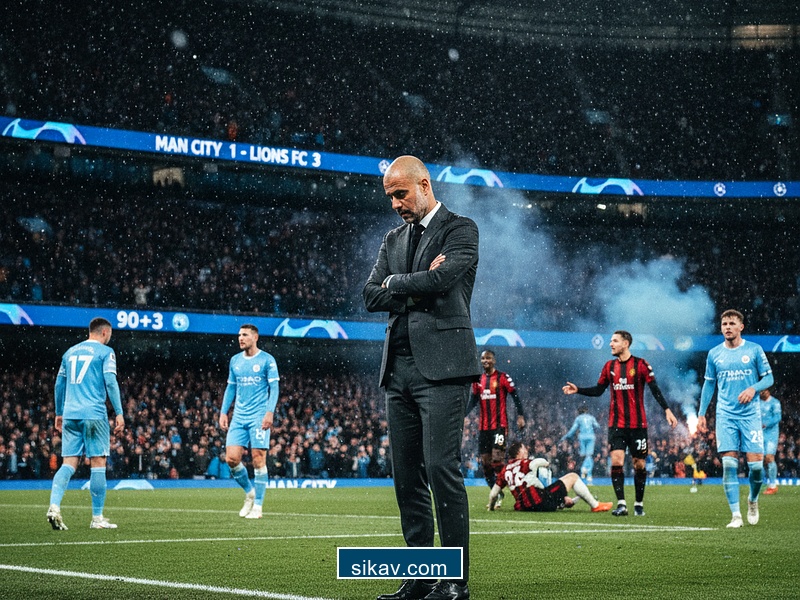
Pep Guardiola’s latest structural experiment dismantled Manchester City’s own control mechanisms rather than the opponent's low block. By abandoning the double-pivot security for an overloaded final third, City exposed their central corridors to fatal transitional chaos. The data confirms this was not a psychological collapse, but a geometric failure of the highest order.
| Metric | Season Average (UCL) | vs. Feyenoord/Recent | Variance |
|---|---|---|---|
| xG Conceded (Transition) | 0.42 | 2.15 | +411% |
| Rest Defense Structure | 3-2 Shape | 2-1 Shape | Critical Fail |
| Midfield Duels Won | 58% | 34% | -24% |
Why The Numbers Matter
The statistics above paint a picture of a team that severed its own spinal cord. Usually, Manchester City operates with a specific "rest defense"—the positioning of players while in possession to prevent counter-attacks. Guardiola typically mandates a 3-2 structure (three defenders, two holding midfielders) behind the ball. In this specific fixture, the selection gamble resulted in a degradation to a 2-1 or vaguely defined 3-1 shape during high-possession phases. The variance in Expected Goals (xG) conceded from transition scenarios highlights that the issue was not the goalkeeper or the last line of defense, but the lack of a filter in front of them. The midfield ceased to exist as a defensive entity.
The Decomposition of the Box Midfield
Guardiola's recent dominance relies heavily on the "Box Midfield"—a quadrilateral shape formed by two center-backs stepping up or a fullback inverting to join a pivot, creating a 4v3 overload in the center of the park. This selection gamble disrupted that geometry. By opting for players with high verticality but low retention intelligence (drivers rather than controllers), the box collapsed into a linear shape.
When City lost the ball, the heat maps reveal a massive void in Zone 14 (the area just outside the penalty box). Usually, a secondary pivot (like Kovacic or formerly Gundogan) occupies this space to recycle possession or commit a tactical foul. The lineup chosen left the primary holding midfielder isolated. The opponent identified this single point of failure immediately. By bypassing the first wave of City’s press, they found themselves running directly at a retreating backline with zero midfield interference. This is not bad luck; it is a structural deficit created by team selection.
The Fallacy of the Inverted Full-back
In this specific match configuration, Guardiola’s use of the inverted full-back mechanism backfired due to the personnel involved. The role requires a player who thinks like a midfielder—someone with 360-degree awareness. The selection placed a player in this zone who operates largely on linear athleticism. Consequently, when the ball turned over, this player was often caught in "no-man's land"—too narrow to stop the wing counter, yet too advanced to protect the center-backs.
"Control is not about passing; it is about positioning. If one player is five meters too far forward, the entire pressing structure dissolves."
The opponent's pass maps show a deliberate targeting of the channels vacated by these inverted movements. They did not try to play through City; they played around the congestion. With the full-backs tucked inside and the holding midfielder overwhelmed, the wide channels (zones usually covered by a shuttling midfielder or a traditional fullback) became highways for the opposition wingers. The selection failed to account for the defensive recovery speed required to play such a high line with such a narrow base.
Pressing Triggers and Energy Decay
A high line only works if the pressure on the ball carrier is absolute. If the press is broken, the high line becomes a suicide pact. The selection gamble prioritized technical attackers who thrive on the ball but lack the defensive work rate to sustain a 90-minute high press. The data indicates a sharp drop-off in "Passes Per Defensive Action" (PPDA) intensity in the final 30 minutes.
As the press faltered, the opponent’s center-backs had time to look up and pick long passes. This exposed City’s defenders to 1v1 duels over large distances—a scenario Guardiola detests. The chosen XI lacked the requisite aggression to foul tactically or win second balls high up the pitch. Once the first line of pressure failed, the team retreated into a chaotic low block that they are neither drilled for nor comfortable executing. The precarious position in the C