
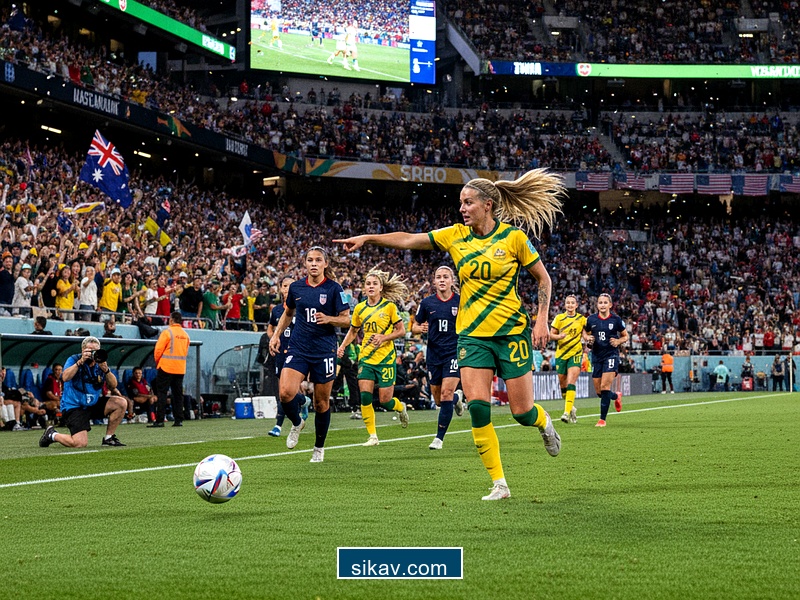
Success in professional sports is often painted in broad, golden strokes. We see the ink drying on the contract, the flashy unveiling video on social media, and the jersey sales spiking in the team store. But for Mackenzie Arnold, the hero of Australia’s World Cup campaign, the reality of the "American Dream" has proven to be a solitary, silent grind. The Matildas' brick wall, affectionately known as "Macca," recently departed the familiar grey skies of London and West Ham United for the NWSL. It was heralded as the move of a lifetime—a lucrative reward for a goalkeeper at the peak of her powers. Yet, as the initial adrenaline fades, a more somber picture emerges. This is not just a story of a transfer; it is a portrait of the profound loneliness that often accompanies the pursuit of greatness.
The goalkeeper stands alone by design. They wear a different kit. They operate within a confined box. They play a different sport from the other twenty players on the pitch. When that professional isolation bleeds into personal existence, the weight becomes crushing. Arnold’s recent confessions about her time in the United States strip away the glamour of the NWSL, revealing the raw, often tragic human cost of chasing the highest dollar and the toughest competition.
The Cultural Chasm: Mateship vs. The Grind
The transition from the Australian or even British way of life to the American sports ecosystem is rarely seamless. Arnold has pointed out a jarring disconnect between her heritage and her current environment. In Australia, the concept of "mateship" is not just a colloquialism; it is the currency of social interaction. It implies a collective suffering, a collective joy, and a barrier-free approach to friendship. In the United Kingdom, where Arnold spent years refining her craft in the Women's Super League, the banter and pub culture provide a similar social lubricant.
"There is a hardness to the American system. It is transactional. You are an asset first, a person second. The warmth takes longer to find."
The United States offers facilities that rival palaces and salaries that change lives. However, Arnold has noted the struggle to penetrate the social bubbles of her new home. The American mindset, particularly in elite athletics, focuses intensely on the individual journey—the "grind." For an Australian accustomed to the communal spirit of the Matildas, where the team is a second family, this shift feels like walking into a room where everyone is speaking a language you almost understand, but miss the nuance of entirely.
She describes a distinct difficulty in forming the deep connections that sustain an athlete through the inevitable dips in form. When the final whistle blows in Portland or San Diego, the locker room clears, and the silence that follows is deafening. For a player who thrives on connection, this cultural coldness acts as an anchor, dragging down the spirit even as the bank account rises.
A History of Overcoming Silence
To understand why this isolation hits Arnold so hard, one must look at her biography. This is the woman who stood tall against France in the World Cup Quarter Final, saving three penalties and smashing one home herself. She looked invincible. But vulnerability has always shadowed her strength. Arnold discovered her hearing loss later in life, a revelation that contextualized years of feeling slightly out of step with the world around her.
| Era | Club/Location | The Psychological State |
|---|---|---|
| 2020-2024 | West Ham (London) | Comfort, Established Hierarchy, Proximity to Europe. |
| 2023 (World Cup) | Australia (Home) | National Heroism, Peak Connection, "The Tillies." |
| 2024-Present | Portland Thorns (USA) | Financial Peak, Cultural Isolation, Professional solitude. |
Navigating the world with hearing loss requires a specific type of energy. It requires constant focus to track conversations, to read lips, to ensure you are part of the joke. In a familiar environment with old friends (like her Matildas teammates), this burden is shared. Her teammates know how to communicate with her. In a new, high-pressure American environment, that safety net vanishes. The effort to connect doubles. The exhaustion is not just physical from training; it is cognitive and emotional.
When Arnold speaks of the differences between the US and home, she is implicitly speaking about the loss of her support system. The "lucrative deal" mentioned in reports compensates for her talent, but it cannot compensate for the feeling of being truly heard—both literally and metaphorically.
The Burden of Expectations
Why leave? Why abandon the comfort of the WSL? Because the nature of the tragic hero is the refusal to settle. Arnold moved to the NWSL because it is widely regarded as the most athletic, transitional, and difficult league in the world for a goalkeeper. She sought the fire. She wanted to prove that her World Cup heroics were not a flash in the pan, but the standard of her legacy.
However, the timing offers a cruel twist. The Matildas are currently in a state of flux, following a disappointing Olympic campaign. The collective armor of the national team has cracked. Arnold does not have the sanctuary of a winning national team to retreat to mentally. She is fighting wars on two fronts: the struggle to adapt to American life and the struggle to maintain her status as one of the world's elite shot-stoppers amidst criticism.
The daily reality she describes—the empty hours after training, the superficial interactions, the longing for Australian sarcasm—paints a picture of a hollow victory. She won the contract. She secured the bag. But she lost the village.
Endurance as the Only Option
This is not a eulogy for a career; Arnold is too talented for that.