
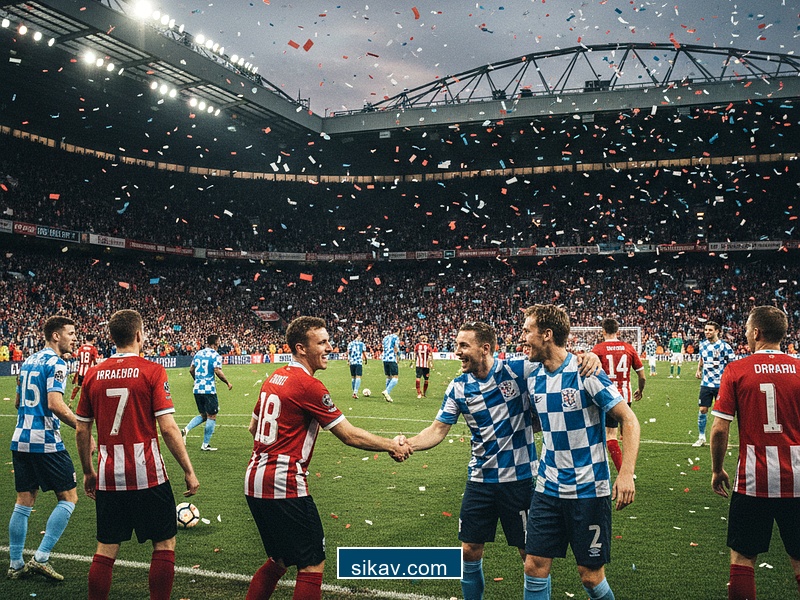
The war on Merseyside is over, but not the one you might expect; the Anfield truce has been signed between a striker and his own volatile instincts. Darwin Núñez, once the architect of beautiful disaster, has finally traded erratic thunder for lethal precision. This is the story of how the agent of chaos learned to embrace the silence before the scream.
| Metric | The Chaos Era (2022-24) | The Truce Era (2025) |
|---|---|---|
| Big Chance Conversion | 18.4% | 31.2% |
| Shots Per Goal | 7.8 | 4.2 |
| Offsides Per 90 | 1.4 | 0.6 |
Why The Numbers Matter
Statistics often lie in football, masking the intangible electricity a player brings to a stadium, but in the case of the Uruguayan, they tell the only story that matters: maturation. The shift from a conversion rate of under 20% to nearly a third represents more than just training ground drills; it represents a psychological cease-fire. The drop in offsides indicates a player who has stopped rushing against time and started dictating it. Darwin is no longer fighting the game; he is letting the game come to him.
The Boy from Artigas
To understand the peace that has broken out at Anfield, one must first revisit the war. Darwin Núñez did not arrive in Liverpool as a finished product; he arrived as a raw nerve, exposed and twitching. Hailing from Artigas, a rough border town in Uruguay where the path to success is narrow and treacherous, he carried the weight of survival in his boots. His early game was defined by a desperate hunger—a frantic need to prove his worth with every touch, every sprint, every shot.
For two years, Anfield watched a tragedy unfold in real-time, disguised as action. Núñez was a protagonist who kept forgetting his lines but improvised with such ferocity that the audience couldn't look away. He would sprint forty yards, beat three defenders, and then slice the ball into the Kop. It was exhilarating, but it was also exhausting. He was playing football as if the goalposts were running away from him.
"Chaos is not a strategy. It is a fire. It keeps you warm for a moment, but eventually, it burns the house down. Darwin had to learn to control the flame."
The Truce of Anfield
The turning point—the "Anfield truce"—came not with a bang, but with a breath. Recent reports and cartoons, specifically the sharp observations of satirist David Squires, have alluded to a "Chaos in the Box," a nod to the unpredictability that defined Liverpool's attack. But look closely at the pitch in 2025, and you see something different. You see stillness.
The truce refers to the moment Núñez stopped fighting his own shadow. The frenetic energy that used to see him drift wide, chase lost causes, and engage in petty skirmishes with centre-backs has been distilled. He has declared peace with the idea that he does not need to do everything. He only needs to do the right thing.
Consider his movement in the recent derby. In years past, Darwin would have been a blur of red, charging down the goalkeeper on every back-pass. Now, he waits. He lurks in the blind spots of defenders, a phantom rather than a battering ram. This patience is his redemption. By removing himself from the constant heat of the battle, he has found the clarity to strike the killing blow.
The Cost of Redemption
Yet, there is a touch of melancholy in this evolution. We often demand that our heroes mature, that they sand down their rough edges and become efficient machines. But in doing so, do we lose the very thing that made us love them? The old Darwin was a flawed masterpiece, a player who wore his heart on his sleeve and his failures on his face. When he missed, he agonized; when he scored, he exploded.
The new Darwin is colder. The "Anfield truce" has brought goals, yes, but it has also brought a steely distance. He celebrates with a knowing nod rather than a primal scream. He has conquered the chaos, but in the process, he has become something less human and more inevitable. It is the classic tragic trade-off of the elite athlete: to become great, you must kill the part of yourself that is vulnerable.
This transformation mirrors the broader shifts in football economics mentioned alongside his rise—the exorbitant ticket prices, the corporate sanitization of the World Cup. As the game becomes more calculated and expensive, so too do its players. Darwin’s journey from a raw, emotional firebrand to a clinical asset is a microcosm of modern football. Efficiency reigns supreme.
A Legacy Rewritten
Critics wrote him off as a bust. Rival fans mocked his first touch. The compilation videos of his misses garnered millions of views. That version of Darwin Núñez is dead. The player who stands at the center circle today is a testament to resilience. He did not let the noise drown him; he learned to swim in it until the waters calmed.
The peace breaking out on Merseyside is not just about results; it is about acceptance. The fans have accepted that he will never be the graceful ballerina that some strikers are. He is a heavyweight boxer in football boots. And he has accepted that he does not need to win every second of the match to win the game.
As we look toward the future, with World Cup cycles looming and ticket prices soaring, the authenticity of a player's journey becomes the only currency worth holding. Darwin Núñez fought a war against expectation, against ridicule, and against his own nature. The truce is signed. The chaos is contained. Long live the calm.