
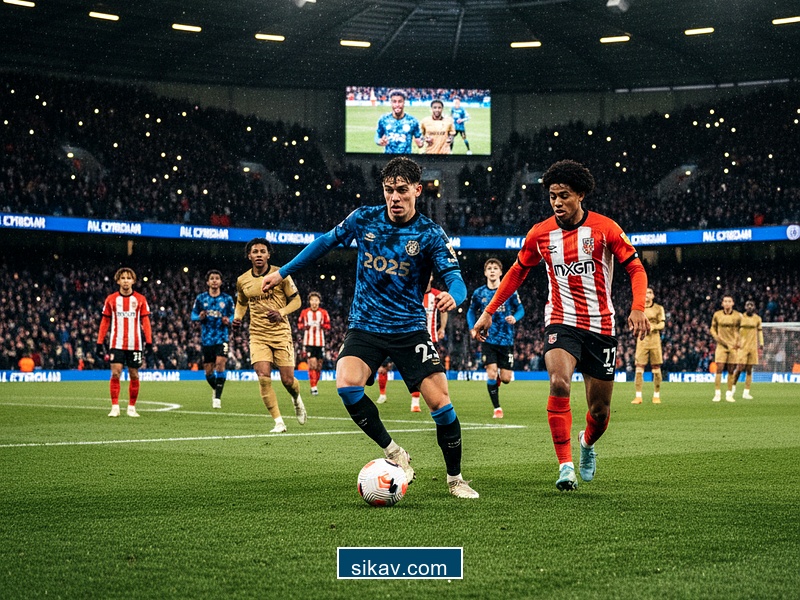
Time is the most ruthless defender in football. It tackles hard, leaves scars, and eventually retires us all. It feels like only yesterday we were scrutinizing the emergence of a scrawny teenager named Wayne Rooney or wondering if Cesc Fàbregas was too slight for the English midfield. Yet here we are, staring down the barrel of the "Class of 2025"—young men born between September 2008 and August 2009.
To contextualize this, these players were born during the season Cristiano Ronaldo won his first Ballon d'Or at Manchester United. They have no memory of a world where Lionel Messi was not a demigod. They are the first true "iPad Generation" of footballers, their tactical education likely beginning on screens before they ever grazed a knee on a Sunday league pitch. The Guardian’s annual selection of the best first-year scholars is more than a list; it is a prophecy, often destined to fail, but fascinating nonetheless.
The Industrialization of Hope
We must address the uncomfortable truth lurking behind these shiny profiles. In the 1990s, youth development was an organic, somewhat chaotic process. Sir Alex Ferguson’s "Class of '92" was an anomaly, a alignment of stars that convinced two decades of football administrators that success could be photocopied. It cannot.
Today, the academy system is a high-tech factory. The charm has eroded. We are no longer looking for the maverick spirit of a Paul Gascoigne or the raw aggression of a Steven Gerrard. The Class of 2025 is comprised of technicians—clones of clones, designed to function within rigid pressing structures. They pass with laser precision, they understand the "half-turn" before they understand long division, but one has to wonder: have we coached the personality out of them?
"We are creating PlayStation footballers who know every button combination but don't know how to survive when the controller disconnects. The grit is gone."
Furthermore, the motivation for clubs has shifted darkly. In the era of Profit and Sustainability Rules (PSR), an academy graduate is no longer just a potential captain; he is "Pure Profit." Chelsea’s recent firesale of academy talent demonstrates this explicitly. These young men highlighted in the Class of 2025 are not just footballers; they are financial levers waiting to be pulled. It is a cynical view, but one borne of the modern game’s financial realities.
The Tactical Defect: The Guardiola Effect
This cohort is significant because they are the first to have their entire footballing consciousness shaped by Pep Guardiola's arrival in English football. When Guardiola landed at City in 2016, these boys were seven or eight years old—the prime age for skill acquisition.
Consequently, we are seeing a homogenization of talent. Every midfielder wants to be Rodri; every goalkeeper believes they are Ederson. The traditional English "number 9"—the bruising center-forward who thrives on chaos—is extinct in this age bracket. The 2025 scholars are versatile, fluid, and technically immaculate. However, when the rain is lashing down at Stoke (or more likely, a damp Tuesday in a PL2 fixture at Stevenage), can they dig in? The history of the Premier League is written by those who could blend silk with steel. The current academy curriculum seems to have forgotten the steel.
The Stat Pack: A History of Attrition
Optimism is the currency of the pre-season, but history provides a sobering audit. Looking back at "Next Generation" lists from a decade ago reveals the brutal difficulty of the transition from scholar to star.
| Cohort Year | Notable Success | The "Lost" Talent | PL Retention Rate |
|---|---|---|---|
| 2014 | Marcus Rashford | Dominic Solanke (Late bloomer) | ~4% |
| 2016 | Trent Alexander-Arnold | Angel Gomes (Exit required) | ~6% |
| 2018 | Bukayo Saka | Xavi Simons (moved abroad) | ~5% |
| 2025 (Projected) | TBD | TBD | Est. < 3% |
The trend is visible. While the elite ceiling is higher (Saka, Foden), the middle class of the Premier League is increasingly filled with imports rather than academy graduates. The retention rate is dropping as the league becomes a global super-competition. For the Class of 2025, the path to the first team is blocked not just by veterans, but by £60m signings from Brazil and France.
Fan Pulse: The Last Bastion of Romance
Despite the cynicism of the boardroom and the brutality of the statistics, the fans remain hopelessly romantic. There is no roar quite like the one reserved for "one of our own."
Scanning the forums of Manchester United, Liverpool, and Arsenal, the mood regarding this new intake is a mixture of desperate hope and protective anxiety. United fans, weary of expensive flops, look at their U18s winning the treble last year and see the only pure thing left at the club. Arsenal fans see the legacy of Hale End as a badge of honor that money cannot buy.
- The Fear: That these talents will be sold to balance the books before they ever kick a ball at the Emirates or Anfield.
- The Hope: Finding the next Harry Kane or Phil Foden—a player who saves the club £100m.
- The Reality: Fans are tracking U18 games more than ever before, seeking an antidote to the mercenary nature of the mo
Time is the most ruthless defender in football. It tackles hard, leaves scars, and eventually retires us all. It feels like only yesterday we were scrutinizing the emergence of a scrawny teenager named Wayne Rooney or wondering if Cesc Fàbregas was too slight for the English midfield. Yet here we are, staring down the barrel of the "Class of 2025"—young men born between September 2008 and August 2009.
To contextualize this, these players were born during the season Cristiano Ronaldo won his first Ballon d'Or at Manchester United. They have no memory of a world where Lionel Messi was not a demigod. They are the first true "iPad Generation" of footballers, their tactical education likely beginning on screens before they ever grazed a knee on a Sunday league pitch. The Guardian’s annual selection of the best first-year scholars is more than a list; it is a prophecy, often destined to fail, but fascinating nonetheless.
The Industrialization of Hope
We must address the uncomfortable truth lurking behind these shiny profiles. In the 1990s, youth development was an organic, somewhat chaotic process. Sir Alex Ferguson’s "Class of '92" was an anomaly, a alignment of stars that convinced two decades of football administrators that success could be photocopied. It cannot.
Today, the academy system is a high-tech factory. The charm has eroded. We are no longer looking for the maverick spirit of a Paul Gascoigne or the raw aggression of a Steven Gerrard. The Class of 2025 is comprised of technicians—clones of clones, designed to function within rigid pressing structures. They pass with laser precision, they understand the "half-turn" before they understand long division, but one has to wonder: have we coached the personality out of them?
"We are creating PlayStation footballers who know every button combination but don't know how to survive when the controller disconnects. The grit is gone."
Furthermore, the motivation for clubs has shifted darkly. In the era of Profit and Sustainability Rules (PSR), an academy graduate is no longer just a potential captain; he is "Pure Profit." Chelsea’s recent firesale of academy talent demonstrates this explicitly. These young men highlighted in the Class of 2025 are not just footballers; they are financial levers waiting to be pulled. It is a cynical view, but one borne of the modern game’s financial realities.
The Tactical Defect: The Guardiola Effect
This cohort is significant because they are the first to have their entire footballing consciousness shaped by Pep Guardiola's arrival in English football. When Guardiola landed at City in 2016, these boys were seven or eight years old—the prime age for skill acquisition.
Consequently, we are seeing a homogenization of talent. Every midfielder wants to be Rodri; every goalkeeper believes they are Ederson. The traditional English "number 9"—the bruising center-forward who thrives on chaos—is extinct in this age bracket. The 2025 scholars are versatile, fluid, and technically immaculate. However, when the rain is lashing down at Stoke (or more likely, a damp Tuesday in a PL2 fixture at Stevenage), can they dig in? The history of the Premier League is written by those who could blend silk with steel. The current academy curriculum seems to have forgotten the steel.
The Stat Pack: A History of Attrition
Optimism is the currency of the pre-season, but history provides a sobering audit. Looking back at "Next Generation" lists from a decade ago reveals the brutal difficulty of the transition from scholar to star.
| Cohort Year | Notable Success | The "Lost" Talent | PL Retention Rate |
|---|---|---|---|
| 2014 | Marcus Rashford | Dominic Solanke (Late bloomer) | ~4% |
| 2016 | Trent Alexander-Arnold | Angel Gomes (Exit required) | ~6% |
| 2018 | Bukayo Saka | Xavi Simons (moved abroad) | ~5% |
| 2025 (Projected) | TBD | TBD | Est. < 3% |
The trend is visible. While the elite ceiling is higher (Saka, Foden), the middle class of the Premier League is increasingly filled with imports rather than academy graduates. The retention rate is dropping as the league becomes a global super-competition. For the Class of 2025, the path to the first team is blocked not just by veterans, but by £60m signings from Brazil and France.
Fan Pulse: The Last Bastion of Romance
Despite the cynicism of the boardroom and the brutality of the statistics, the fans remain hopelessly romantic. There is no roar quite like the one reserved for "one of our own."
Scanning the forums of Manchester United, Liverpool, and Arsenal, the mood regarding this new intake is a mixture of desperate hope and protective anxiety. United fans, weary of expensive flops, look at their U18s winning the treble last year and see the only pure thing left at the club. Arsenal fans see the legacy of Hale End as a badge of honor that money cannot buy.
- The Fear: That these talents will be sold to balance the books before they ever kick a ball at the Emirates or Anfield.
- The Hope: Finding the next Harry Kane or Phil Foden—a player who saves the club £100m.
- The Reality: Fans are tracking U18 games more than ever before, seeking an antidote to the mercenary nature of the mo