
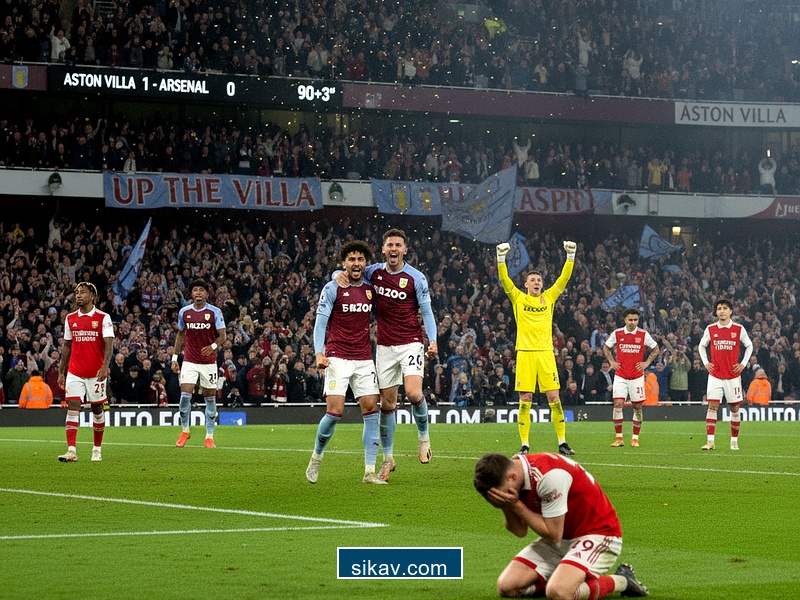
The Bold Claim: Mikel Arteta is actively sabotaging Arsenal’s title charge, not through a lack of tactical acumen, but through a reckless refusal to utilize his squad depth which is driving his starting eleven into a physiological wall. The narrative that Arsenal were simply "unlucky" against Aston Villa is a comfortable lie; the reality is that the Gunners looked like a heavyweight boxer trying to fight in the twelfth round without having trained for the distance. If you cannot rotate without fearing a collapse in quality, you have already lost the Premier League title race to Manchester City.
The 1-0 defeat at Villa Park wasn't merely a dropped three points; it was a diagnostic reading of a system approaching critical failure. While the scoreboard reflects a narrow margin defined by John McGinn’s early strike, the underlying data suggests a team running on fumes before the Christmas decorations have even settled. We need to dissect exactly why Arsenal "ran out of gas" and why Unai Emery’s specific setup was the perfect stress test to break a fatigued machine.
The Physiology of the Press: Why Legs Matter More Than Shape
Modern football, particularly the brand Arteta subscribes to, is predicated on the efficiency of the high press. It is a system that demands absolute physical peak performance. When Arsenal is at their best, they suffocate opponents in their own third. However, at Villa Park, we saw the tangible effects of cognitive and physical fatigue. The "energy crisis" alluded to in reports isn't just about running less distance; it is about the sharpness of the reaction.
Look closely at the build-up to the goal. It wasn't a tactical misalignment where a player didn't know where to stand. It was a failure of intensity. In the opening exchanges, Villa moved the ball with a zip and purpose that Arsenal simply couldn't match in the duels. When you are tired, your brain processes spatial information milliseconds slower. You arrive at the tackle a fraction late. You track the runner, but you don't get tight enough to prevent the turn.
"Fatigue makes cowards of us all, but in the Premier League, it makes you mediocre. Arsenal's inability to sustain their high-line press allowed Villa to play through them with frightening ease in transition."
Arteta’s refusal to rotate key components—Bukayo Saka, Declan Rice, and William Saliba specifically—meant that against a high-energy Villa side, Arsenal were operating at 85% capacity. In the Premier League, that 15% deficit is where you lose games.
Unai Emery’s Masterclass in Verticality
We cannot analyze this loss without crediting the tactical architecture of Unai Emery. While Arteta champions control, Emery thrives on organized chaos and verticality. Villa’s high line is often criticized as risky, but against a tired team, it is a weapon. By condensing the pitch, Emery forced Arsenal to play in tight pockets where physical sharpness is mandatory.
The Trap Was Set
Villa knew that Arsenal, facing a quick turnaround in fixtures, would struggle to recover if the game became a track meet. Emery instructed his side to bypass the midfield quickly. Bailey and McGinn weren't looking to retain possession for the sake of it; they were looking to isolate Arsenal’s full-backs one-on-one. Zinchenko, in particular, was targeted. The Ukrainian is a passing genius but a defensive liability when isolated, and Villa exploited this ruthlessly.
- Transition Speed: Villa moved the ball from back to front in under 4 seconds during key phases, bypassing a lethargic Arsenal midfield press.
- Defensive Compactness: When Arsenal did have the ball, Villa’s 4-4-2 block was incredibly narrow, forcing Arsenal wide where they lacked the explosive energy to beat markers.
- The Physical Battle: Villa won the majority of 50/50 duels in the first half. This is the clearest statistical indicator of one team wanting it more, or rather, having more energy to give.
The December Red Zone: A Strategic Crisis
The snippet mentions the "busy festive season" starting, but for Arsenal, the crisis is already here. The data regarding minutes played is alarming. While Pep Guardiola constantly rotates his Manchester City squad—swapping Doku for Grealish, or Alvarez for Haaland without blinking—Arteta seems paralyzed by the fear of a drop-off.
This creates a compounding issue. Players like Saka are not just physically tired; they are accumulating micro-traumas that lead to long-term injury or a sharp decline in form. We saw this last season. Arsenal "ran out of gas" in April because they were red-lining in December. It appears no lessons have been learned. The definition of insanity is doing the same thing twice and expecting a different result; playing the same XI every three days and expecting to maintain intensity is tactical insanity.
Why spend money on Leandro Trossard, Emile Smith Rowe, or Eddie Nketiah if they are not trusted to start tough away games? If the gap between the starters and the bench is truly that wide, then the recruitment strategy has failed. If the gap isn't that wide, then the management strategy has failed. There is no third option.
The Implications: Control vs. Lethality
This match highlighted a growing concern regarding Arsenal's offensive output. They dominated possession in the second half, but it was sterile. This is the "horseshoe of death"—passing around the perimeter of the box without penetration. Why? Because penetration requires dynamic movement. It requires a burst of acceleration to get past a defender. A tired team passes to feet; a fresh team passes into space.
Martin Ødegaard, usually the conductor, looked heavy. Gabriel Jesus, vital for his link-up play, lacked the sharpness to turn half-chances into goals. When the cognitive load is too high due to fatigue, decision-making suffers. Arsenal had chances to equalize, but they were squandered through poor execution—a classic symptom of a team playing on empty batteries.
Looking Ahead: The Adaptation Requirement
This loss must serve as a watershed moment for Mikel Arteta. The Premier League is a war of attrition. Villa Park has become a fortress (15 consecutive home wins is a staggering statistic), but title winners go to fortresses and find a way to escape with a point, or they possess the squad depth to match the home team's energy.
If Arsenal continues on this trajectory—rigid selection, high minutes for key stars, and high-intensity demands—they will not be lifting the trophy in May. They will be watching Manchester City or Liverpool surge past them in February when the physical toll becomes insurmountable. The "energy crisis" is not a weather event that will pass; it is a structural flaw in the manager's approach. To fix it, Arteta must do the one thing he hates most: release control and trust his squad.
The Bold Claim: Mikel Arteta is actively sabotaging Arsenal’s title charge, not through a lack of tactical acumen, but through a reckless refusal to utilize his squad depth which is driving his starting eleven into a physiological wall. The narrative that Arsenal were simply "unlucky" against Aston Villa is a comfortable lie; the reality is that the Gunners looked like a heavyweight boxer trying to fight in the twelfth round without having trained for the distance. If you cannot rotate without fearing a collapse in quality, you have already lost the Premier League title race to Manchester City.
The 1-0 defeat at Villa Park wasn't merely a dropped three points; it was a diagnostic reading of a system approaching critical failure. While the scoreboard reflects a narrow margin defined by John McGinn’s early strike, the underlying data suggests a team running on fumes before the Christmas decorations have even settled. We need to dissect exactly why Arsenal "ran out of gas" and why Unai Emery’s specific setup was the perfect stress test to break a fatigued machine.
The Physiology of the Press: Why Legs Matter More Than Shape
Modern football, particularly the brand Arteta subscribes to, is predicated on the efficiency of the high press. It is a system that demands absolute physical peak performance. When Arsenal is at their best, they suffocate opponents in their own third. However, at Villa Park, we saw the tangible effects of cognitive and physical fatigue. The "energy crisis" alluded to in reports isn't just about running less distance; it is about the sharpness of the reaction.
Look closely at the build-up to the goal. It wasn't a tactical misalignment where a player didn't know where to stand. It was a failure of intensity. In the opening exchanges, Villa moved the ball with a zip and purpose that Arsenal simply couldn't match in the duels. When you are tired, your brain processes spatial information milliseconds slower. You arrive at the tackle a fraction late. You track the runner, but you don't get tight enough to prevent the turn.
"Fatigue makes cowards of us all, but in the Premier League, it makes you mediocre. Arsenal's inability to sustain their high-line press allowed Villa to play through them with frightening ease in transition."
Arteta’s refusal to rotate key components—Bukayo Saka, Declan Rice, and William Saliba specifically—meant that against a high-energy Villa side, Arsenal were operating at 85% capacity. In the Premier League, that 15% deficit is where you lose games.
Unai Emery’s Masterclass in Verticality
We cannot analyze this loss without crediting the tactical architecture of Unai Emery. While Arteta champions control, Emery thrives on organized chaos and verticality. Villa’s high line is often criticized as risky, but against a tired team, it is a weapon. By condensing the pitch, Emery forced Arsenal to play in tight pockets where physical sharpness is mandatory.
The Trap Was Set
Villa knew that Arsenal, facing a quick turnaround in fixtures, would struggle to recover if the game became a track meet. Emery instructed his side to bypass the midfield quickly. Bailey and McGinn weren't looking to retain possession for the sake of it; they were looking to isolate Arsenal’s full-backs one-on-one. Zinchenko, in particular, was targeted. The Ukrainian is a passing genius but a defensive liability when isolated, and Villa exploited this ruthlessly.
- Transition Speed: Villa moved the ball from back to front in under 4 seconds during key phases, bypassing a lethargic Arsenal midfield press.
- Defensive Compactness: When Arsenal did have the ball, Villa’s 4-4-2 block was incredibly narrow, forcing Arsenal wide where they lacked the explosive energy to beat markers.
- The Physical Battle: Villa won the majority of 50/50 duels in the first half. This is the clearest statistical indicator of one team wanting it more, or rather, having more energy to give.
The December Red Zone: A Strategic Crisis
The snippet mentions the "busy festive season" starting, but for Arsenal, the crisis is already here. The data regarding minutes played is alarming. While Pep Guardiola constantly rotates his Manchester City squad—swapping Doku for Grealish, or Alvarez for Haaland without blinking—Arteta seems paralyzed by the fear of a drop-off.
This creates a compounding issue. Players like Saka are not just physically tired; they are accumulating micro-traumas that lead to long-term injury or a sharp decline in form. We saw this last season. Arsenal "ran out of gas" in April because they were red-lining in December. It appears no lessons have been learned. The definition of insanity is doing the same thing twice and expecting a different result; playing the same XI every three days and expecting to maintain intensity is tactical insanity.
Why spend money on Leandro Trossard, Emile Smith Rowe, or Eddie Nketiah if they are not trusted to start tough away games? If the gap between the starters and the bench is truly that wide, then the recruitment strategy has failed. If the gap isn't that wide, then the management strategy has failed. There is no third option.
The Implications: Control vs. Lethality
This match highlighted a growing concern regarding Arsenal's offensive output. They dominated possession in the second half, but it was sterile. This is the "horseshoe of death"—passing around the perimeter of the box without penetration. Why? Because penetration requires dynamic movement. It requires a burst of acceleration to get past a defender. A tired team passes to feet; a fresh team passes into space.
Martin Ødegaard, usually the conductor, looked heavy. Gabriel Jesus, vital for his link-up play, lacked the sharpness to turn half-chances into goals. When the cognitive load is too high due to fatigue, decision-making suffers. Arsenal had chances to equalize, but they were squandered through poor execution—a classic symptom of a team playing on empty batteries.
Looking Ahead: The Adaptation Requirement
This loss must serve as a watershed moment for Mikel Arteta. The Premier League is a war of attrition. Villa Park has become a fortress (15 consecutive home wins is a staggering statistic), but title winners go to fortresses and find a way to escape with a point, or they possess the squad depth to match the home team's energy.
If Arsenal continues on this trajectory—rigid selection, high minutes for key stars, and high-intensity demands—they will not be lifting the trophy in May. They will be watching Manchester City or Liverpool surge past them in February when the physical toll becomes insurmountable. The "energy crisis" is not a weather event that will pass; it is a structural flaw in the manager's approach. To fix it, Arteta must do the one thing he hates most: release control and trust his squad.