
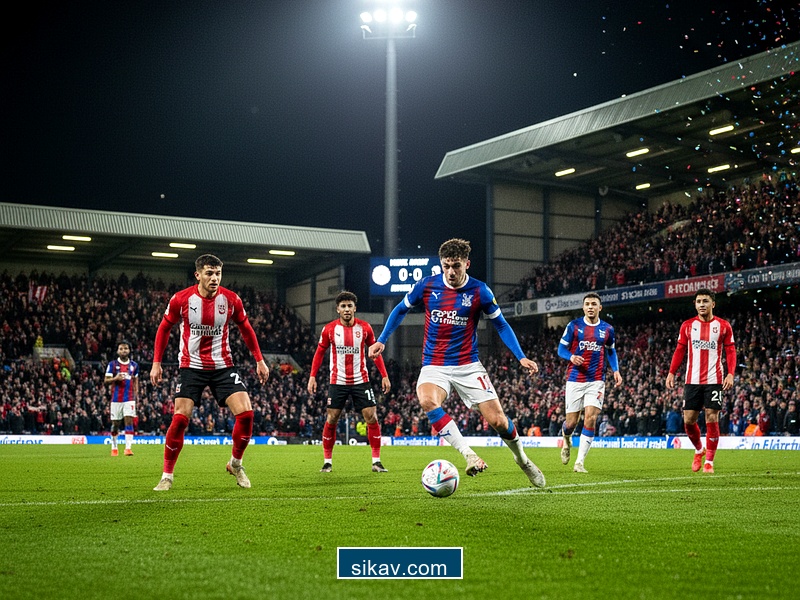
The Bold Claim: For the vast majority of their existence, Crystal Palace has been a club defined by survival, not conquest; a localized institution content with the domestic grind rather than the continental dream. To suggest otherwise is to look at history through rose-tinted spectacles. We have spent decades watching the Eagles fight gravity, perpetually worried about the drop, treating mid-table obscurity as the summit of our ambition. But what we witnessed in Dublin—a clinical, arrogant, 3-0 dismantling of Shelbourne—suggests that the DNA of this South London institution is finally being rewritten.
The Anomaly of Ease
It was a wet, drizzly evening at Tolka Park. The conditions were ripe for a "classic cup upset"—the kind of narrative English football usually relishes, where the plucky underdog muddies the waters and drags the Premier League aristocrats down to their level. Yet, Oliver Glasner’s men refused to read from that tired script. Instead, they produced a performance of such professional detachment that it felt almost foreign to those of us who remember the chaotic Palace sides of yesteryear.
The 3-0 scoreline doesn't just represent three points; it represents a widening chasm between the Palace of old and the Palace of now. In previous eras, a trip across the Irish Sea would have been a scrappy affair, likely settled by a set-piece or a moment of individual grit. Here, with Pino pulling strings and manipulating space with the ease of a veteran, the Eagles were in cruise control. To see Palace play with this level of entitlement—the good kind of entitlement—is a jarring, yet welcome, shift in perspective.
"The travelling Eagles fans have already visited Norway, Poland, France and Ireland and can now look forward to at least one more stamp on their passports."
This sentence alone carries more weight than perhaps the modern fan realizes. For a club that has spent much of the last thirty years yo-yoing between divisions or flirting with administration, the accumulation of passport stamps is not merely a logistical detail. It is the fulfillment of a deferred promise.
Echoes of the Unfulfilled Nineties
To truly understand the gravity of this Conference League run, we must look back to the ghosts that haunt Selhurst Park. We must talk about the 1990-1991 season. That year, under Steve Coppell, Palace finished third in the top flight. It was a zenith, a moment where Ian Wright and Mark Bright terrorized defenses across the land. By all rights, that team earned a place in the UEFA Cup.
But history is cruel. The ban on English clubs following the Heysel disaster was only gradually being lifted, and Palace was the sacrificial lamb, denied their European adventure due to coefficient technicalities. That "lost generation" of fans never got their trip to Naples, Munich, or Barcelona. They were left with the Zenith Data Systems Cup—a domestic consolation prize that, while cherished, was hardly the continental glory they deserved.
Now, over three decades later, the wheel has finally turned. When we see the squad boarding planes to Poland or navigating the rain in Dublin, we are not just watching a group stage match; we are witnessing the closing of a painful circle. This is the adventure the Coppell generation was denied. Glasner isn't just managing a football team; he is curating a historical correction.
The Evolution of Ambition
- Then (1990s): Relying on British grit and the individual brilliance of Wright/Bright.
- The Wilderness Years (2000-2010): Administration, survival, and short-term loans.
- The Hodgson Era: Stability, structure, and risk-aversion.
- The Glasner Era: High-pressing, European methodology, and squad depth capable of rotation.
The performance of Pino against Shelbourne epitomizes this new era. In the past, a player of such technical quality might have been bypassed by a long-ball strategy or sold at the first sign of profit. Today, he is the fulcrum of a side that looks comfortable in possession on foreign soil. He dictated the tempo, finding pockets of space that simply shouldn't exist against a low block, and ensured that the "Northern Irish opponents"—or rather, the Dublin-based stalwarts of the League of Ireland—could never get close enough to leave a mark.
More Than Just a Group Stage
The skeptics will look at the opposition—Shelbourne—and shrug. They will say, "It's only the Conference League." They will point to the disparity in wage bills and argue that a 3-0 victory is the bare minimum requirement. Those critics miss the point entirely.
For a club like Crystal Palace, consistency is the hardest currency to acquire. Historically, a European campaign would be the kiss of death for league form—the squad too thin, the travel too wearying. Remember Ipswich Town? Remember Bolton Wanderers? Clubs that flew too close to the European sun and burned their domestic wings.
Yet, Glasner has navigated this with a serenity that belies the club's chaotic past. With the knockout spot all but secured, he has bought himself the l
The Bold Claim: For the vast majority of their existence, Crystal Palace has been a club defined by survival, not conquest; a localized institution content with the domestic grind rather than the continental dream. To suggest otherwise is to look at history through rose-tinted spectacles. We have spent decades watching the Eagles fight gravity, perpetually worried about the drop, treating mid-table obscurity as the summit of our ambition. But what we witnessed in Dublin—a clinical, arrogant, 3-0 dismantling of Shelbourne—suggests that the DNA of this South London institution is finally being rewritten.
The Anomaly of Ease
It was a wet, drizzly evening at Tolka Park. The conditions were ripe for a "classic cup upset"—the kind of narrative English football usually relishes, where the plucky underdog muddies the waters and drags the Premier League aristocrats down to their level. Yet, Oliver Glasner’s men refused to read from that tired script. Instead, they produced a performance of such professional detachment that it felt almost foreign to those of us who remember the chaotic Palace sides of yesteryear.
The 3-0 scoreline doesn't just represent three points; it represents a widening chasm between the Palace of old and the Palace of now. In previous eras, a trip across the Irish Sea would have been a scrappy affair, likely settled by a set-piece or a moment of individual grit. Here, with Pino pulling strings and manipulating space with the ease of a veteran, the Eagles were in cruise control. To see Palace play with this level of entitlement—the good kind of entitlement—is a jarring, yet welcome, shift in perspective.
"The travelling Eagles fans have already visited Norway, Poland, France and Ireland and can now look forward to at least one more stamp on their passports."
This sentence alone carries more weight than perhaps the modern fan realizes. For a club that has spent much of the last thirty years yo-yoing between divisions or flirting with administration, the accumulation of passport stamps is not merely a logistical detail. It is the fulfillment of a deferred promise.
Echoes of the Unfulfilled Nineties
To truly understand the gravity of this Conference League run, we must look back to the ghosts that haunt Selhurst Park. We must talk about the 1990-1991 season. That year, under Steve Coppell, Palace finished third in the top flight. It was a zenith, a moment where Ian Wright and Mark Bright terrorized defenses across the land. By all rights, that team earned a place in the UEFA Cup.
But history is cruel. The ban on English clubs following the Heysel disaster was only gradually being lifted, and Palace was the sacrificial lamb, denied their European adventure due to coefficient technicalities. That "lost generation" of fans never got their trip to Naples, Munich, or Barcelona. They were left with the Zenith Data Systems Cup—a domestic consolation prize that, while cherished, was hardly the continental glory they deserved.
Now, over three decades later, the wheel has finally turned. When we see the squad boarding planes to Poland or navigating the rain in Dublin, we are not just watching a group stage match; we are witnessing the closing of a painful circle. This is the adventure the Coppell generation was denied. Glasner isn't just managing a football team; he is curating a historical correction.
The Evolution of Ambition
- Then (1990s): Relying on British grit and the individual brilliance of Wright/Bright.
- The Wilderness Years (2000-2010): Administration, survival, and short-term loans.
- The Hodgson Era: Stability, structure, and risk-aversion.
- The Glasner Era: High-pressing, European methodology, and squad depth capable of rotation.
The performance of Pino against Shelbourne epitomizes this new era. In the past, a player of such technical quality might have been bypassed by a long-ball strategy or sold at the first sign of profit. Today, he is the fulcrum of a side that looks comfortable in possession on foreign soil. He dictated the tempo, finding pockets of space that simply shouldn't exist against a low block, and ensured that the "Northern Irish opponents"—or rather, the Dublin-based stalwarts of the League of Ireland—could never get close enough to leave a mark.
More Than Just a Group Stage
The skeptics will look at the opposition—Shelbourne—and shrug. They will say, "It's only the Conference League." They will point to the disparity in wage bills and argue that a 3-0 victory is the bare minimum requirement. Those critics miss the point entirely.
For a club like Crystal Palace, consistency is the hardest currency to acquire. Historically, a European campaign would be the kiss of death for league form—the squad too thin, the travel too wearying. Remember Ipswich Town? Remember Bolton Wanderers? Clubs that flew too close to the European sun and burned their domestic wings.
Yet, Glasner has navigated this with a serenity that belies the club's chaotic past. With the knockout spot all but secured, he has bought himself the l